Water Cycle and Types of Clouds: Two Wren and Sitka Nature Lessons, Grades 3-5
The water cycle explains where the rain comes from. Clouds tell your child when it is coming. Together they turn the sky into something readable from the back step.
By the end of this
- Your child can explain why we cannot make more water, only move it around the cycle
- Your child can look at the clouds and say what weather to expect this afternoon
Your child is ready for this if they
- Reads a short paragraph without help
- Writes a sentence in their own words
- Will go outside and look at something for five minutes
That list matters more than the age we printed on it. You know which of the two is true of your child.
Heat from the sun turns liquid water into invisible vapor and lifts it into the air. That is evaporation, and it happens most from oceans, lakes, and puddles.
Plants add to it. Water pulled up through roots evaporates out of leaves, which is the transpiration from the tree lesson doing double duty.
High up, air is colder. Vapor cools and turns back into tiny droplets around specks of dust. That is condensation, and a cloud is what a crowd of those droplets looks like.
When droplets combine until they are too heavy to float, they fall as rain, snow, sleet, or hail. That is precipitation.
Water on the ground runs downhill into streams and rivers, or soaks in and becomes groundwater. Either way it heads back toward the sea and the whole thing starts again.
Clouds get named for two things: their shape and their height. Learn a handful of words and you can read most skies.
Cumulus clouds are the puffy cotton ones with flat bottoms. A few of them means fair weather. If they pile up tall through the afternoon they become cumulonimbus, and that is a thunderstorm.
Stratus clouds are flat gray sheets covering the whole sky, low down. They bring drizzle and gloom rather than storms. Fog is a stratus cloud sitting on the ground.
Cirrus clouds are thin wispy streaks very high up, made of ice crystals. They often show up a day or so before a change in weather.
The word nimbus in a cloud name always means rain is involved.
What is inside
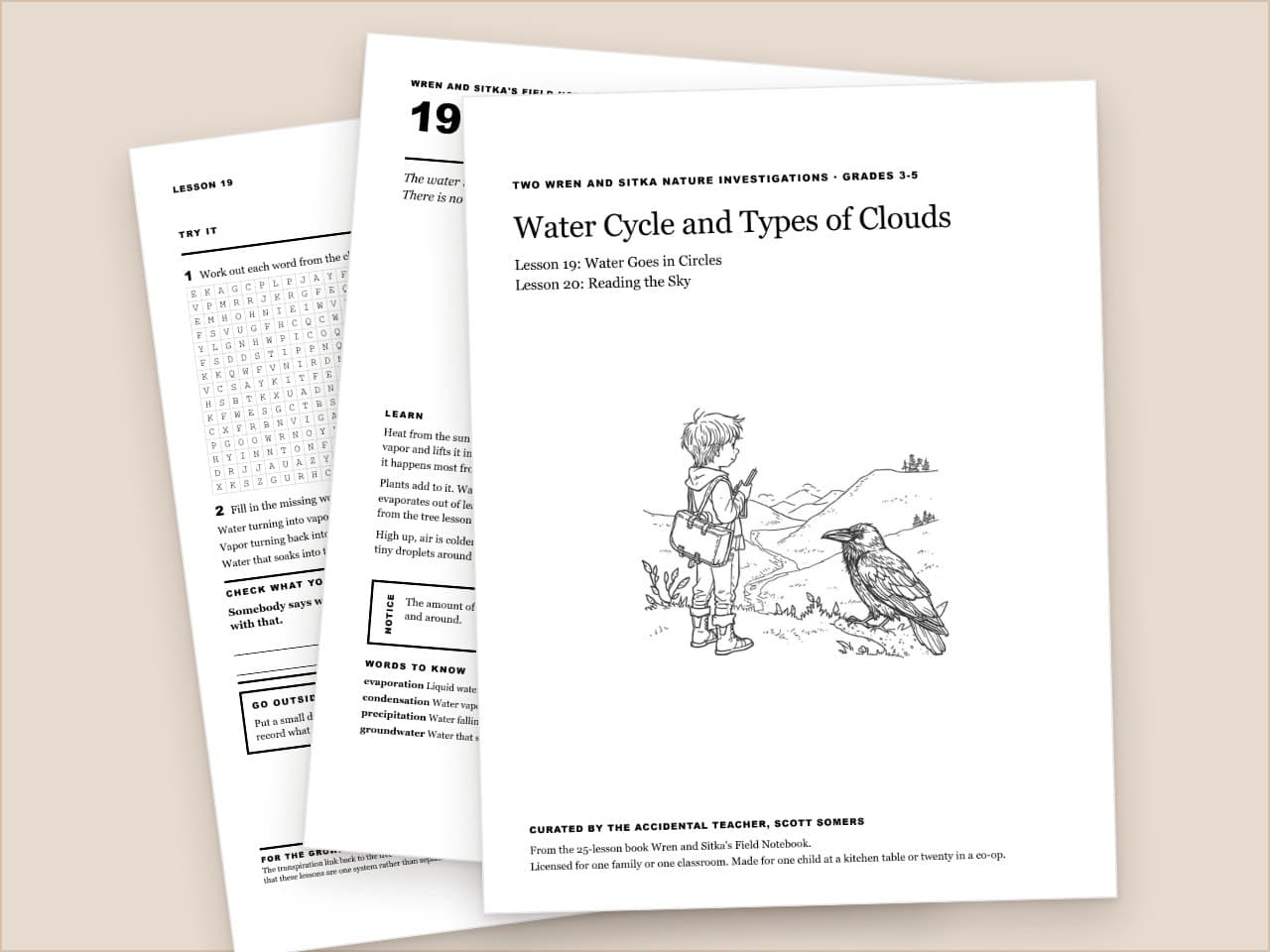
- 01Water Goes in Circles — the teaching page
- 02Water Goes in Circles — the work page, answerable from the teaching page
- 03Take it outside: Put a small dish of water outside in the sun and mark the level with a pen.
- 04Reading the Sky — the teaching page
- 05Reading the Sky — the work page, answerable from the teaching page
- 06Take it outside: Look at the sky at the same time for three days and name what you see.
Standards alignment, for a portfolio or a state filing
3 alignments. Copy what your state asks for and ignore the rest — this is here for the paperwork, not for the teaching.
| Framework | Code | What it covers |
|---|---|---|
| NGSS | 3-ESS2-1 | |
| NGSS | 5-ESS2-1 | |
| NGSS | 5-ESS2-2 |