Wren and Sitka's Field Notebook: 25 Nature Science Lessons Bundle, Grades 3-5
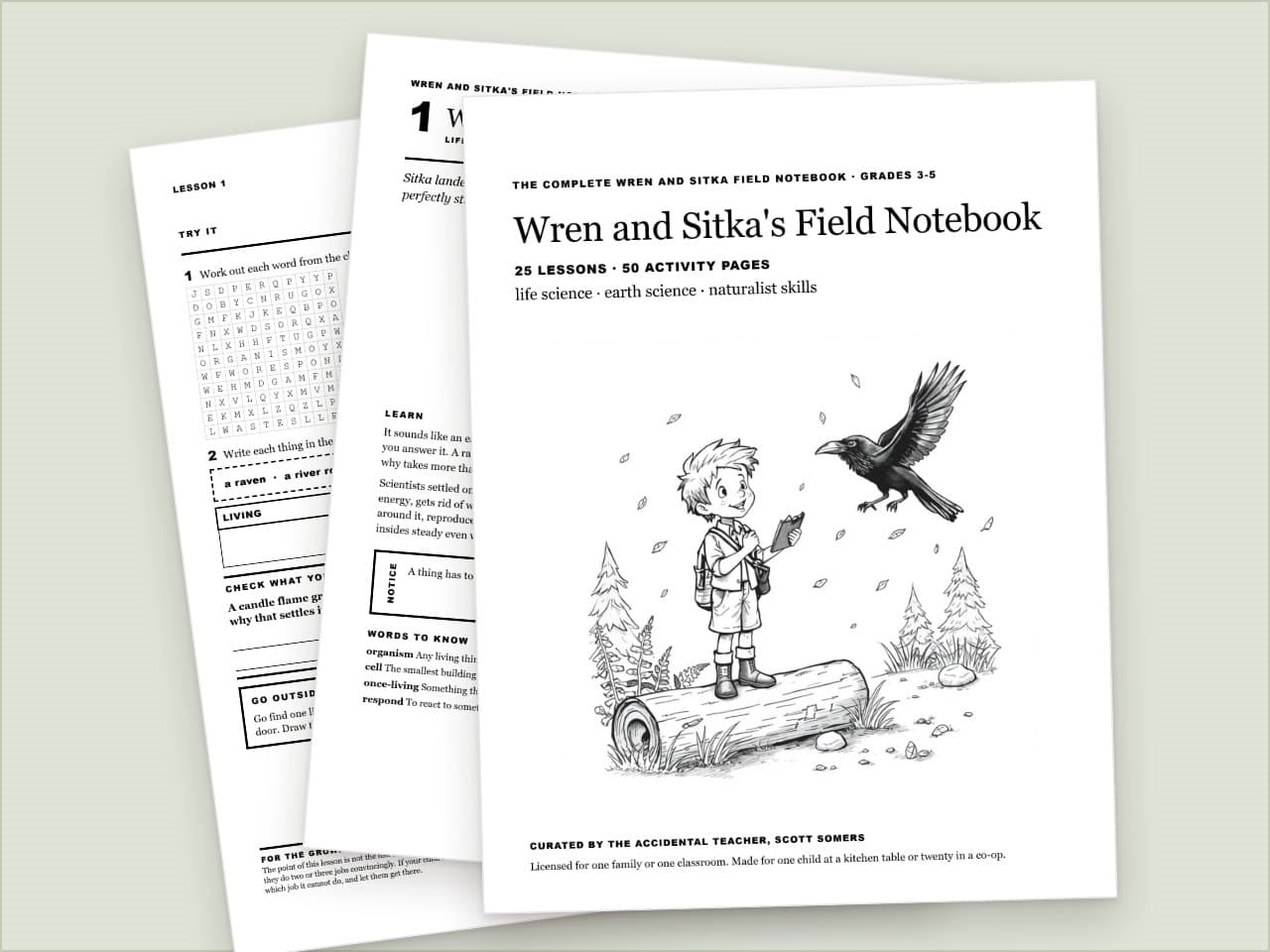
Twenty five investigations. One pencil. Whatever is outside your door. This is the complete Wren and Sitka's Field Notebook, the same book sold in print, as one letter size PDF.
By the end of this
- Your child can say why a candle flame and a river are not alive, using the whole list of jobs a living thing does
- Your child can tell a dog family track from a cat family track by looking for claw marks
- Your child can look at a bird's beak and say what it most likely eats
- Your child can explain why a split feather stops working, and what a bird does about it
- Your child can name what a raven does that shows it understands what another animal saw
- Your child can name the four stages of complete metamorphosis and say why the caterpillar and butterfly eat different food
- Your child can explain how a dead salmon feeds a tree growing well back from the water
- Your child can draw a food chain with the arrows pointing the right way, and say why they point at the eater
- Your child can explain why a picky eater is in more trouble than a generalist when one food disappears
- Your child can guess whether an animal hunts or is hunted by where its eyes sit
- Your child can tell camouflage from mimicry and say what each one is telling a predator
- Your child can name the three ways an animal survives winter and say what each one costs
- Your child can explain what actually lifts water to the top of a tall tree, with no pump involved
- Your child can read a stump and say what the weather was like in a given year
- Your child can explain what a plant gets in return for the energy it spends making sweet fruit
- Your child can explain what a leaf's green colour tells you about the sunlight it uses
- Your child can say what is lost when a bare field meets a heavy storm, and why it matters for centuries
- Your child can sort rocks into igneous, sedimentary and metamorphic by looking at them
- Your child can explain why we cannot make more water, only move it around the cycle
- Your child can look at the clouds and say what weather to expect this afternoon
- Your child can name the mistake in using one cold day as evidence about climate
- Your child can explain why the moon changes shape, and why it is not the Earth's shadow
- Your child can find north at night from the Big Dipper, and say why a dim star beats a bright one
- Your child can explain how two animals share a habitat but never a niche
- Your child can separate what they observed from what they think it means, and mark which is which
Your child is ready for this if they
- Reads a short paragraph without help
- Writes a sentence in their own words
- Will go outside and look at something for five minutes
That list matters more than the age we printed on it. You know which of the two is true of your child.
Life science, earth science, and the naturalist habit itself. Tracks in the mud, why a leaf is green, how a tree lifts water a hundred feet with no pump, what dirt is made of, why the moon changes shape, how to find north without a compass, and how to keep a field journal worth keeping. Wren is a boy naturalist about ten years old and Sitka is a raven who turned up uninvited.
Four crosswords, three clue-based word searches, three label the diagram plates, plus sorting, matching, drawing, and written response across all twenty five sheets. A complete answer key sits at the back, not on any child page.
What is inside
- 0101. What Makes Something Alive?
- 0202. Reading Tracks
- 0303. Beaks and What They Eat
- 0404. Feathers and Flight
- 0505. How Smart Is a Raven?
- 0606. The Complete Change
- 0707. The Salmon's Journey
- 0808. Who Eats Whom
- 0909. It Is Not a Line
- 1010. Predator and Prey
- 1111. Hiding in Plain Sight
- 1212. Three Ways to Survive Winter
- 1313. How a Tree Drinks
- 1414. Reading Time in a Stump
- 1515. How Seeds Travel
- 1616. How a Leaf Eats Light
- 1717. What Dirt Is Made Of
- 1818. Three Kinds of Rock
- 1919. Water Goes in Circles
- 2020. Reading the Sky
- 2121. Weather Is Not Climate
- 2222. Why the Moon Changes Shape
- 2323. Finding North Without a Compass
- 2424. Putting It All Together
- 2525. Keeping a Field Journal
Standards alignment, for a portfolio or a state filing
27 alignments. Copy what your state asks for and ignore the rest — this is here for the paperwork, not for the teaching.
| Framework | Code | What it covers |
|---|---|---|
| NGSS | 3-ESS2-1 | |
| NGSS | 3-ESS2-2 | |
| NGSS | 3-LS1-1 | |
| NGSS | 3-LS4-2 | |
| NGSS | 3-LS4-3 | |
| NGSS | 3-LS4-4 | |
| NGSS | 4-LS1-1 | |
| NGSS | 5-ESS2-1 | |
| NGSS | 5-ESS2-2 | |
| NGSS | 5-LS1-1 | |
| NGSS | 5-LS2-1 | |
| NGSS | 5-PS3-1 | |
| NGSS | 2-LS2-2 | |
| NGSS | 4-ESS1-1 | |
| NGSS | 4-ESS2-1 | |
| NGSS | 4-LS1-2 | |
| CCSS-MATH | 4.MD.A.1 | |
| NGSS | 5-ESS1-2 | |
| NGSS | 5-ESS3-1 | |
| NGSS | K-LS1-1 | |
| NGSS | MS-ESS1-1 | |
| NGSS | MS-ESS2-1 | |
| CCSS-ELA | RI.4.1 | |
| NGSS | SEP-3 | |
| NGSS | SEP-4 | |
| NGSS | SEP-6 | |
| NGSS | SEP-8 |