Types of Rocks and What Soil Is Made Of: Two Wren and Sitka Lessons, Grades 3-6
One sheet on where a rock came from, which has exactly three possible answers. One on what dirt actually is, which turns out to be the most crowded place your child walks on every day without looking.
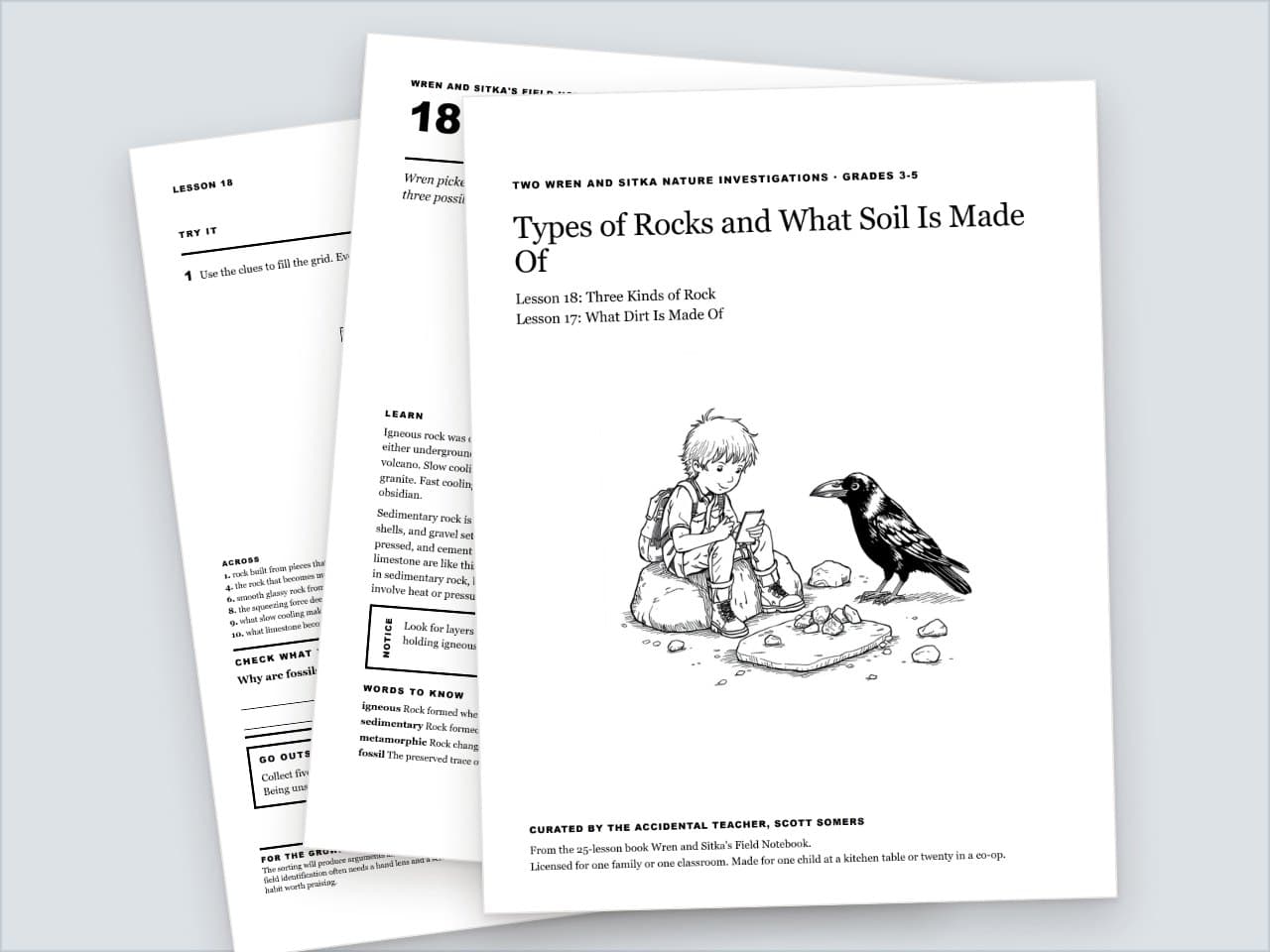
By the end of this
- Your child can sort rocks into igneous, sedimentary and metamorphic by looking at them
- Your child can say what is lost when a bare field meets a heavy storm, and why it matters for centuries
Your child is ready for this if they
- Reads a short paragraph without help
- Writes a sentence in their own words
- Will go outside and look at something for five minutes
That list matters more than the age we printed on it. You know which of the two is true of your child.
Igneous rock was once melted. It cooled and hardened, either underground slowly or on the surface fast after a volcano. Slow cooling makes big visible crystals like in granite. Fast cooling makes smooth glassy rock like obsidian.
Sedimentary rock is built from pieces. Sand, mud, shells, and gravel settle in layers, get buried and pressed, and cement together. Sandstone and limestone are like this. Fossils are almost always found in sedimentary rock, because the other two kinds involve heat or pressure that destroys them.
Metamorphic rock was changed. Heat and pressure deep underground squeezed and cooked an existing rock into something new without melting it. Limestone becomes marble. Shale becomes slate.
The three kinds turn into each other. Heat and pressure cook one kind into another, weather and water break rock into pieces that settle and press into new rock, and melting starts the whole thing over. That loop is called the rock cycle, and it never finishes.
Soil is not one thing. It is broken rock, dead plants and animals, water, air, and an enormous number of living things, all mixed together.
The broken rock part comes in three sizes. Sand is the biggest and feels gritty. Silt is medium and feels smooth like flour. Clay is the smallest and feels sticky when wet.
The dark crumbly part made of rotted plants and animals is called humus, and it holds water and feeds plants. It is the part that makes soil good.
A single handful of healthy soil holds more living things than there are people on Earth. Bacteria, fungi, worms, and mites are all breaking things down and putting nutrients back.
Dig a hole and you see layers. Dark topsoil on top, paler subsoil under it, then broken rock, then solid bedrock. Making one inch of topsoil can take hundreds of years.
What is inside
- 01Three Kinds of Rock — the teaching page
- 02Three Kinds of Rock — the work page, answerable from the teaching page
- 03Take it outside: Collect five rocks that look different from each other.
- 04What Dirt Is Made Of — the teaching page
- 05What Dirt Is Made Of — the work page, answerable from the teaching page
- 06Take it outside: Dig a small hole about a foot deep somewhere you have permission.
Standards alignment, for a portfolio or a state filing
5 alignments. Copy what your state asks for and ignore the rest — this is here for the paperwork, not for the teaching.
| Framework | Code | What it covers |
|---|---|---|
| NGSS | 4-ESS1-1 | |
| NGSS | 4-ESS2-1 | |
| NGSS | 5-ESS2-1 | |
| NGSS | 5-ESS3-1 | |
| NGSS | MS-ESS2-1 |