Types of Rocks: Igneous, Sedimentary, Metamorphic, Wren and Sitka, Grades 3-6
Where a rock came from is a question with exactly three possible answers, and your child can usually tell which one by looking. Layers mean sedimentary. Visible crystals mean igneous. Both, squeezed and reheated, mean metamorphic.
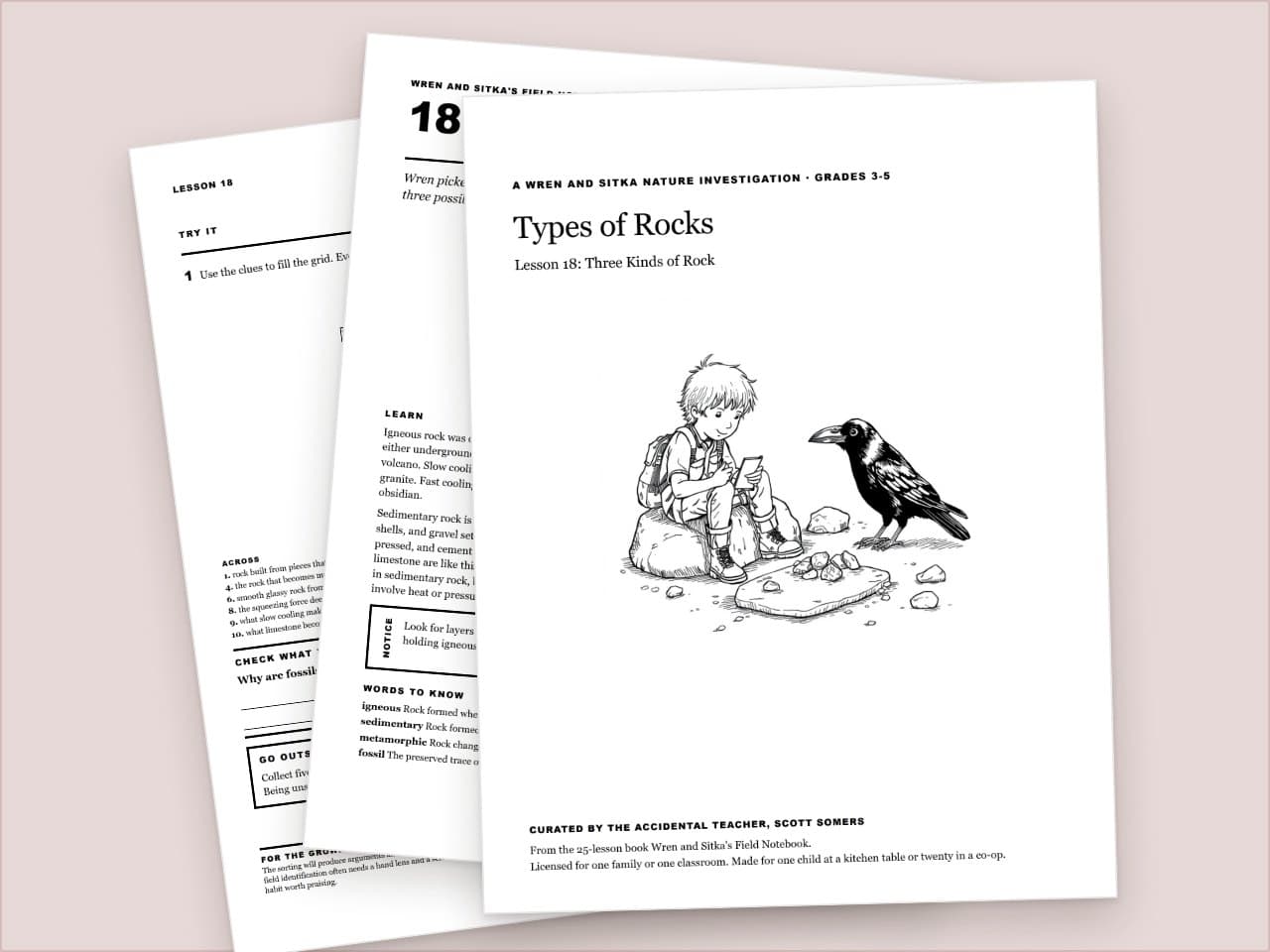
By the end of this
- Your child can sort rocks into igneous, sedimentary and metamorphic by looking at them
Your child is ready for this if they
- Reads a short paragraph without help
- Writes a sentence in their own words
- Will go outside and look at something for five minutes
That list matters more than the age we printed on it. You know which of the two is true of your child.
Igneous rock was once melted. It cooled and hardened, either underground slowly or on the surface fast after a volcano. Slow cooling makes big visible crystals like in granite. Fast cooling makes smooth glassy rock like obsidian.
Sedimentary rock is built from pieces. Sand, mud, shells, and gravel settle in layers, get buried and pressed, and cement together. Sandstone and limestone are like this. Fossils are almost always found in sedimentary rock, because the other two kinds involve heat or pressure that destroys them.
Metamorphic rock was changed. Heat and pressure deep underground squeezed and cooked an existing rock into something new without melting it. Limestone becomes marble. Shale becomes slate.
The three kinds turn into each other. Heat and pressure cook one kind into another, weather and water break rock into pieces that settle and press into new rock, and melting starts the whole thing over. That loop is called the rock cycle, and it never finishes.
What is inside
- 01Three Kinds of Rock — the teaching page
- 02Three Kinds of Rock — the work page, answerable from the teaching page
- 03Take it outside: Collect five rocks that look different from each other.
Standards alignment, for a portfolio or a state filing
2 alignments. Copy what your state asks for and ignore the rest — this is here for the paperwork, not for the teaching.
| Framework | Code | What it covers |
|---|---|---|
| NGSS | 4-ESS1-1 | |
| NGSS | MS-ESS2-1 |