Types of Sentences Worksheet: Four Kinds, Greek Myths, Grades 3-5
A sentence has a job. It states, asks, commands, or cries out. The end mark is not decoration. It is how the job gets named.
By the end of this
- The end mark is not decoration. It is the sentence telling you what it came to do.
Your child is ready for this if they
- Read a short paragraph on their own and can say what it said
- Know that a sentence opens with a capital letter and closes with a mark
- Will write a sentence of their own rather than only fill in a blank
That list matters more than the age we printed on it. You know which of the two is true of your child.
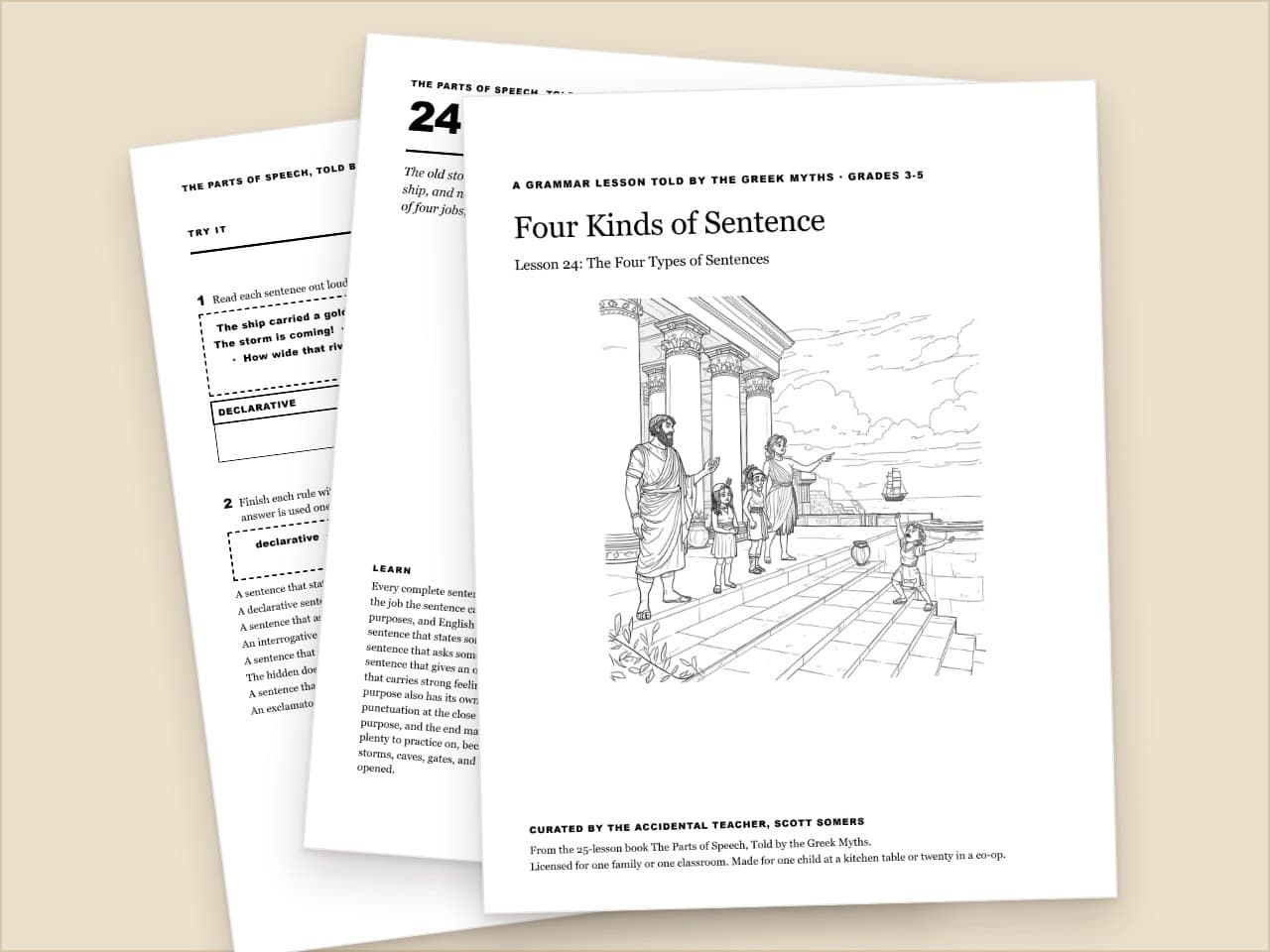
Every complete sentence has a purpose. A purpose is the job the sentence came to do. There are four purposes, and English gives each one a name. A sentence that states something is declarative. A sentence that asks something is interrogative. A sentence that gives an order is imperative. A sentence that carries strong feeling is exclamatory. Each purpose also has its own end mark. An end mark is the punctuation at the close of a sentence. Name the purpose, and the end mark follows. The myths give you plenty to practice on, because they are full of ships, storms, caves, gates, and boxes that should never be opened.
A declarative sentence states something. It tells you a fact or an idea, and it closes with a period. Most of what you read is declarative. "The gods lived on a high mountain." "A hero sailed across the sea." "The ship carried a golden apple." Each one states, so each one takes a period. An interrogative sentence asks something, and it closes with a question mark. It usually begins with a question word such as who, what, where, when, why, or how. "Who guards the gate?" "Where does the road end?" Sometimes there is no question word at the front. Then the sentence turns itself around and a helping word comes first. "Did the ship sail at dawn?" The order of the words is the clue.
An imperative sentence gives an order. It tells someone to do something, and it closes with a period. "Close the door." "Carry the torch into the cave." "Bring me the golden apple." Now look for the doer in those three. There is none. An imperative sentence hides its doer, and the hidden doer is always you. You can prove it. Put the word you in front and read the sentence again. "You close the door." It still makes sense, and now the doer is showing. No other kind of sentence passes that test.
An exclamatory sentence carries strong feeling. It shows surprise, or fear, or delight, and it closes with an exclamation point. "The storm is coming!" "The sea is rising!" Many exclamatory sentences begin with the word how, or with the words what a. Then they name a quality instead of asking for an answer. "How dark that cave is!" "How wide that river is!" "What a strange box it was!" "What a long road it was!" Read one of those out loud and you will hear the feeling in your own voice. That feeling is why the sentence takes the mark it takes.
Here is how to decide, step by step. Step one, read the sentence out loud and ask what it came to do. Step two, if it states something, it is declarative and takes a period. Step three, if it asks something, it is interrogative and takes a question mark. Step four, if it orders someone to act, it is imperative and takes a period. Step five, if it carries strong feeling and orders no one, it is exclamatory and takes an exclamation point. Now work two of them. The first is "Where does the river begin". Read it out loud. It asks, and it opens with a question word, so it is interrogative and it takes a question mark. The second is "Hold the rope with both hands". Read it out loud. It orders, and the doer is hidden, so it is imperative and it takes a period. One warning belongs here. An order stays imperative even when the voice behind it is loud. Feeling does not turn an order into an exclamatory sentence. On this sheet, every order closes with a period.
What is inside
- 01The Four Types of Sentences — the teaching page
- 02The Four Types of Sentences — the work page, answerable from the teaching page
- 03Take it outside: Sit where you can hear people talking, at the supper table or outdoors while the chores get done.
Standards alignment, for a portfolio or a state filing
3 alignments. Copy what your state asks for and ignore the rest — this is here for the paperwork, not for the teaching.
| Framework | Code | What it covers |
|---|---|---|
| CCSS | CCSS.ELA-LITERACY.L.1.1.J | |
| CCSS | CCSS.ELA-LITERACY.L.1.2.B | |
| CCSS | CCSS.ELA-LITERACY.L.3.1.I |