Parts of Speech Worksheet: Label Every Word, Greek Myths, Grades 3-5
The last lesson in the book hands a child a short passage and asks for the job of every word. Not a definition. The job.
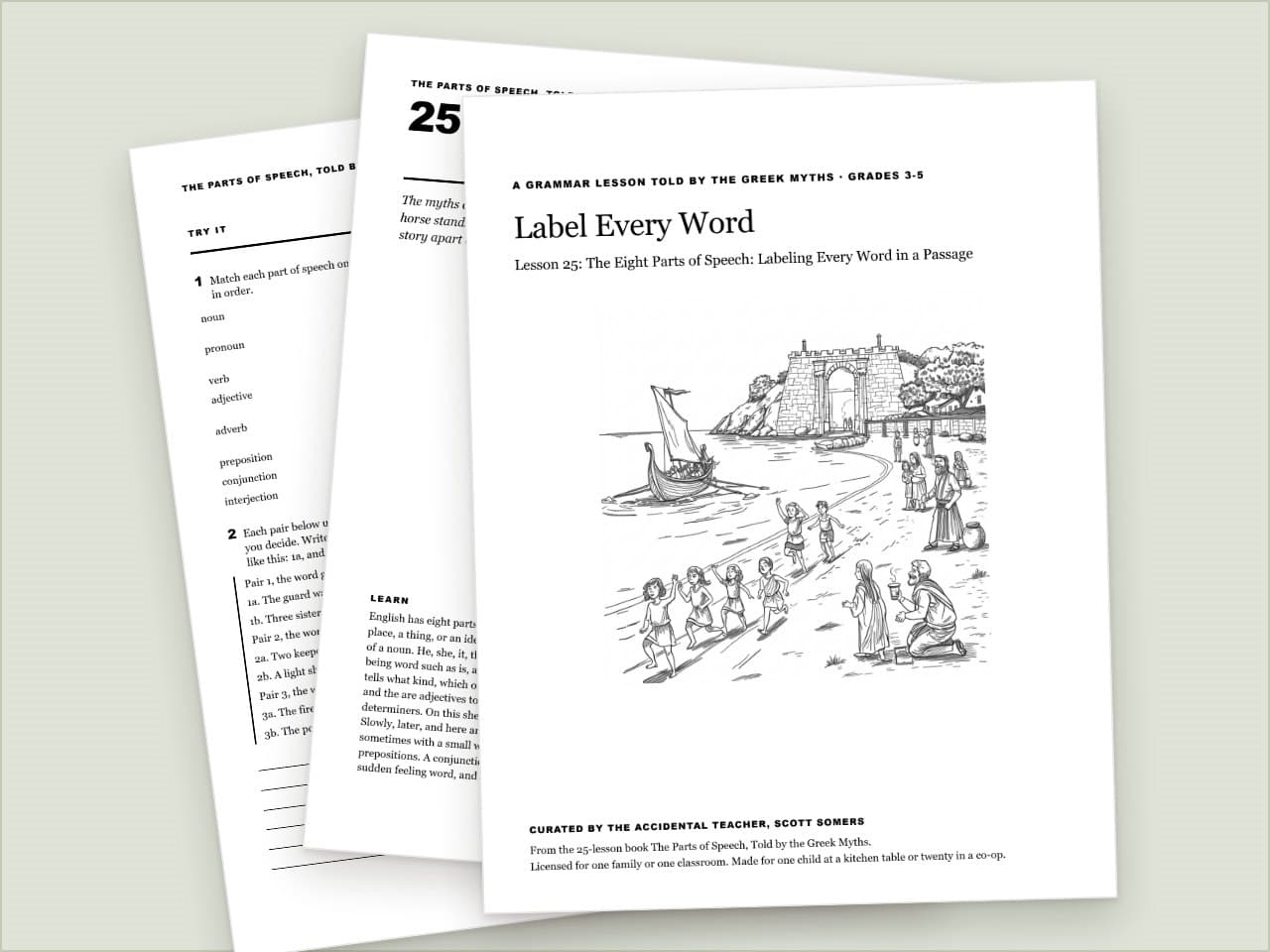
By the end of this
- The label belongs to the job, not to the word. Read the line before you write the label.
Your child is ready for this if they
- Read a short paragraph on their own and can say what it said
- Know that a sentence opens with a capital letter and closes with a mark
- Will write a sentence of their own rather than only fill in a blank
That list matters more than the age we printed on it. You know which of the two is true of your child.
English has eight parts of speech. A part of speech is the name for the job a word does. A noun names a person, a place, a thing, or an idea. Sailors, soldiers, gates, ships, shields, and courage are nouns. A pronoun stands in place of a noun. He, she, it, they, him, her, them, we, and you are pronouns. A verb is the action of the sentence, or a being word such as is, am, was, or were. Rowed, marched, and carried are verbs. An adjective describes a noun. It tells what kind, which one, or how many. Golden, tall, heavy, and three are adjectives. The three small words a, an, and the are adjectives too, and they answer which one. Those three are called articles. Some books call them determiners. On this sheet they land with the adjectives. An adverb tells how, when, or where about the verb. Slowly, later, and here are adverbs. A preposition shows position or direction, and a noun comes after it, sometimes with a small word or two in between. In, on, under, over, across, toward, into, from, and beside are prepositions. A conjunction joins two parts together. And, but, or, and so are conjunctions. An interjection is a sudden feeling word, and a comma or an exclamation point sets it off. Oh, wow, alas, and hurrah are interjections.
Here is the idea that makes this page harder than it looks. The label does not belong to the word. It belongs to the job that word is doing in its own sentence. Read these two lines. The hero won the race. The horses race down the hill. Race is the same word both times. In the first line it names a thing, so it is a noun. In the second line it tells what the horses do, so it is a verb. One word, two labels. Many words work both ways. Race, guard, water, light, and fire can each name a thing in one line and tell what somebody does in the next. Farmers water a field, and the field then holds water. So read the whole line first. Then decide.
Guessing is slow, and a fixed order is faster and surer. Ask these eight questions about one word at a time, and stop at the first yes. One. Is it a sudden feeling word set off by a comma or an exclamation point? Interjection. Two. Does it join two parts together? Conjunction. Three. Does it show position or direction, with a noun after it, sometimes with a small word or two in between? Preposition. Four. Does it stand in place of a name? Pronoun. Five. Does it name a person, a place, a thing, or an idea? Noun. Six. Is it the action of the sentence, or a being word such as is or was? Verb. Seven. Does it describe a noun by telling what kind, which one, or how many? Adjective. Remember that a, an, and the always land here. Eight. Does it tell how, when, or where about the verb? Adverb.
Now watch the eight questions work across a whole sentence. Read the line first. Oh, the tired sailors rowed slowly across the wine-dark sea, and they reached the shore. Oh is a sudden feeling word with a comma after it, so it is an interjection. The is an article, so it is an adjective. Tired describes sailors, so it is an adjective. Sailors names people, so it is a noun. Rowed is the action, so it is a verb. Slowly tells how they rowed, so it is an adverb. Across shows direction and a noun follows it, so it is a preposition. The is an adjective again, and wine-dark describes sea, so that is an adjective too. Sea names a place, so it is a noun. And joins the two parts of the sentence, so it is a conjunction. They stands in place of sailors, so it is a pronoun. Reached is the action of the second part, so it is a verb. The is an adjective one more time, and shore names a place, so shore is a noun. All eight parts of speech are in that one sentence.
You already know how this feels, because you do it every day without thinking. Run down the hill, and run is something you did. Go for a run, and now a run is a thing you went for. Nobody has to tell you which is which. The sentence tells you. Words behave the same way at your house as they do in a myth. Read the line, find the job, then write the label.
What is inside
- 01The Eight Parts of Speech: Labeling Every Word in a Passage — the teaching page
- 02The Eight Parts of Speech: Labeling Every Word in a Passage — the work page, answerable from the teaching page
- 03Take it outside: Walk outside and say one sentence out loud about what you can see from where you are standing.
Standards alignment, for a portfolio or a state filing
3 alignments. Copy what your state asks for and ignore the rest — this is here for the paperwork, not for the teaching.
| Framework | Code | What it covers |
|---|---|---|
| CCSS | CCSS.ELA-LITERACY.L.3.1.A | |
| CCSS | CCSS.ELA-LITERACY.L.5.1.A | |
| CCSS | CCSS.ELA-LITERACY.L.4.1.E |