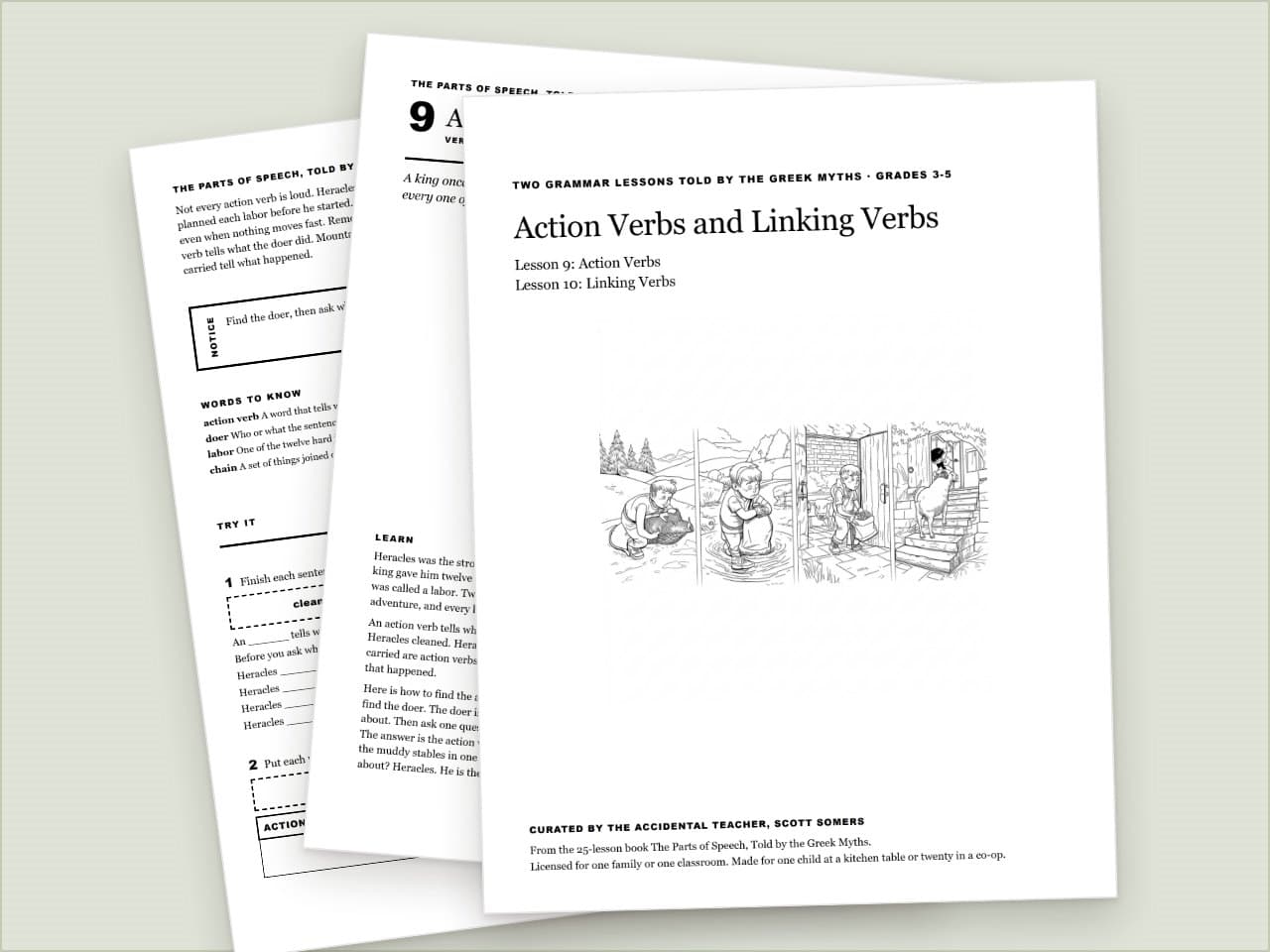
Action Verbs and Linking Verbs: Two Grammar Lessons, Grades 3-5
Some verbs do. Some verbs only join. A child who can tell them apart stops marking is as if it were captured.
By the end of this
- Find the doer, then ask what the doer did. The answer is the action verb.
- An action verb tells what the doer did. A linking verb tells what the doer is.
Your child is ready for this if they
- Read a short paragraph on their own and can say what it said
- Know that a sentence opens with a capital letter and closes with a mark
- Will write a sentence of their own rather than only fill in a blank
That list matters more than the age we printed on it. You know which of the two is true of your child.
Heracles was the strongest man in the old stories. A king gave him twelve hard jobs to finish. Each hard job was called a labor. Twelve labors filled his whole adventure, and every labor was something he did.
An action verb tells what someone or something does. Heracles cleaned. Heracles carried. Cleaned and carried are action verbs. Each one names something that happened.
Here is how to find the action verb in a sentence. First find the doer. The doer is who or what the sentence is about. Then ask one question. What did the doer do? The answer is the action verb. Try it. Heracles cleaned the muddy stables in one day. Who is the sentence about? Heracles. He is the doer. What did Heracles do? He cleaned. So cleaned is the action verb. Try it once more. The river washed the floor for him. What is the sentence about? The river. A river is not a person, but it is still the doer here. What did the river do? It washed. So washed is the action verb.
A retold adventure is a chain of action verbs. Each link in the chain is one thing that happened. Four labors of Heracles came in this order. He captured a wild boar on a snowy mountain. He cleaned the muddy stables in one day. He gathered three golden apples in a far garden. He carried a huge three headed dog up into the daylight, and that dog guarded a dark doorway. Captured, cleaned, gathered, and carried are the four links. Read those four words alone and you still know the story.
Not every action verb is loud. Heracles held the sky on his shoulders while he waited at the edge of the world. He planned each labor before he started. Held, waited, and planned are action verbs too. They tell what the doer did, even when nothing moves fast. Remember the difference between two kinds of words. A noun names. An action verb tells what the doer did. Mountain, stables, garden, and apples name things. Captured, cleaned, gathered, and carried tell what happened.
In the last lesson you found action verbs. An action verb tells what the doer does. It lifts. It runs. It carries. Some verbs do none of that. They do not tell what the doer did. These are linking verbs. A linking verb shows no action. It joins the front of the sentence to a word on the far side. That far side word tells you more about the doer.
The commonest linking verbs are the forms of be. Five of them turn up all the time: am, is, are, was, and were. Three more, be, being, and been, do the same job. Say them in a row until they sound like one long string. I am hungry. Zeus is a king. The owls are gray. Athena was calm. The sailors were tired. Nothing moves in any of those sentences. The verb only links.
Other verbs can link too, such as seem, become, feel, and look. Feel and look are tricky, because sometimes they link and sometimes they act. One test settles it. It is called the is swap test, and it has four steps. Step one. Find the verb. Step two. Take that verb out and put the word is in its place. Step three. Read the new sentence and ask whether it still says the same thing. Step four. If it does, the verb is a linking verb. If it sounds wrong, the verb is an action verb. Worked once: Atlas felt tired. Swap in is. Atlas is tired. That says the same thing, so felt is linking here. Worked again: Atlas felt the cold stone. Swap in is. Atlas is the cold stone. That sounds wrong, so felt is an action verb here.
Now look at the word on the far side of the link. It always points back at the doer. It never points at somebody new. Midas became a king. The king is Midas. Same person. Pan seems happy. The happy one is Pan. Same person. Sometimes that far side word renames the doer, the way king does. Sometimes it describes the doer, the way happy and gray and calm do. Either way it points back. An action verb works the other way. Midas touched the cup. The cup is not Midas. The cup is a new thing.
You use linking verbs all day long. You say I am hungry before dinner. You say the milk looks warm. You say my brother seems tired. Nobody moves a muscle in those sentences. The verb just links you to a word that tells more about you. The old Greek stories work the same way. Iris is quick. Atlas is strong. The myths run on these small quiet verbs as much as on the loud ones.
What is inside
- 01Action Verbs — the teaching page
- 02Action Verbs — the work page, answerable from the teaching page
- 03Take it outside: Go outside and finish one real job, such as feeding an animal, raking leaves, or filling a water bucket.
- 04Linking Verbs — the teaching page
- 05Linking Verbs — the work page, answerable from the teaching page
- 06Take it outside: Stand where your family talks, like the kitchen near dinner time, and listen for two minutes.
Standards alignment, for a portfolio or a state filing
3 alignments. Copy what your state asks for and ignore the rest — this is here for the paperwork, not for the teaching.
| Framework | Code | What it covers |
|---|---|---|
| CCSS | CCSS.ELA-LITERACY.L.3.1.A | |
| CCSS | CCSS.ELA-LITERACY.L.4.1 | |
| CCSS | CCSS.ELA-LITERACY.W.3.3.B |