Types of Sentences and Compound Sentences, Grades 3-5
Four jobs a sentence can have, then the comma and the conjunction that join two whole ones without turning them into a wreck.
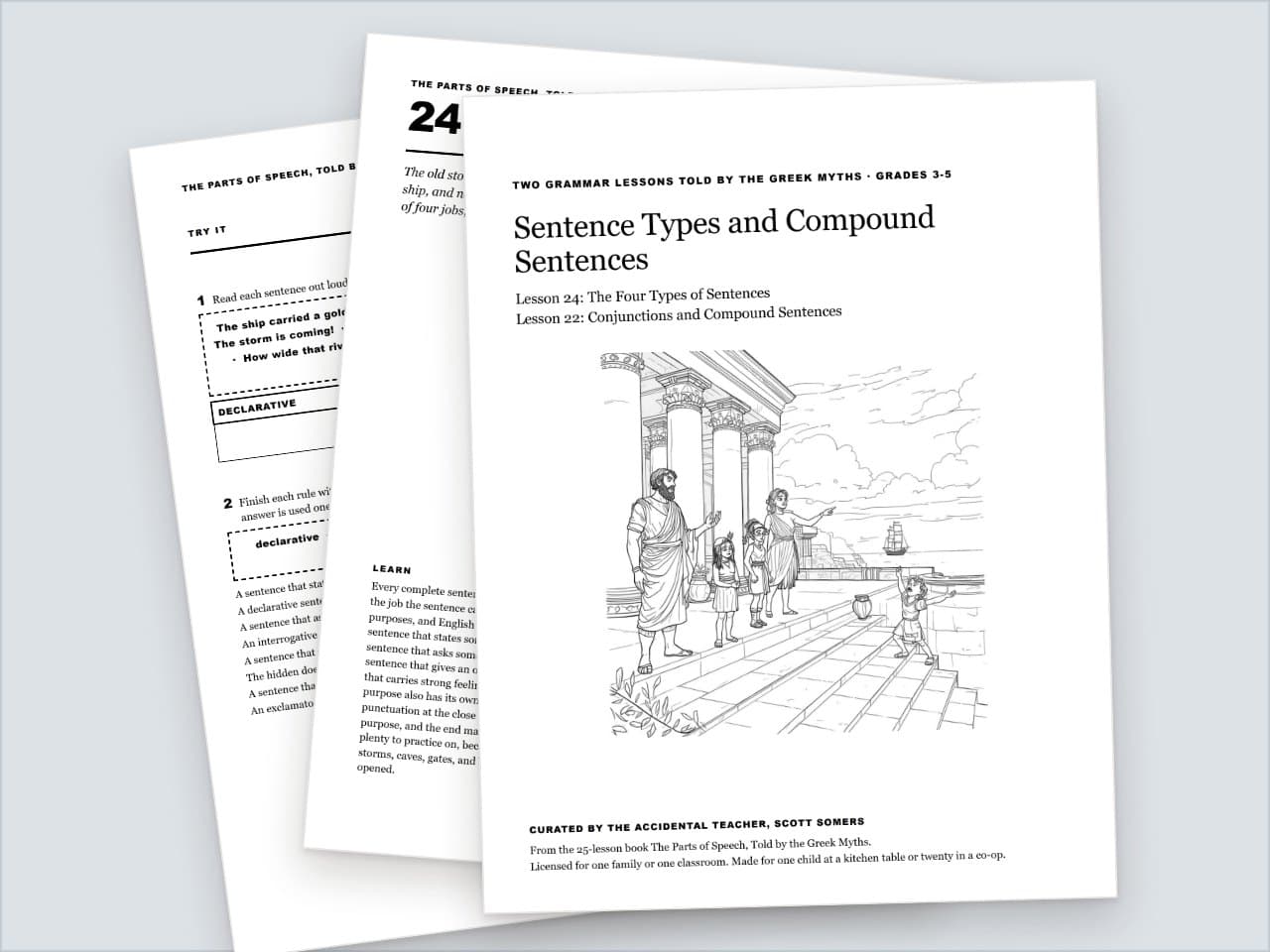
By the end of this
- The end mark is not decoration. It is the sentence telling you what it came to do.
- A comma alone cannot hold two whole sentences together. It needs a conjunction standing right behind it, and the meaning of the two halves picks which conjunction that is.
Your child is ready for this if they
- Read a short paragraph on their own and can say what it said
- Know that a sentence opens with a capital letter and closes with a mark
- Will write a sentence of their own rather than only fill in a blank
That list matters more than the age we printed on it. You know which of the two is true of your child.
Every complete sentence has a purpose. A purpose is the job the sentence came to do. There are four purposes, and English gives each one a name. A sentence that states something is declarative. A sentence that asks something is interrogative. A sentence that gives an order is imperative. A sentence that carries strong feeling is exclamatory. Each purpose also has its own end mark. An end mark is the punctuation at the close of a sentence. Name the purpose, and the end mark follows. The myths give you plenty to practice on, because they are full of ships, storms, caves, gates, and boxes that should never be opened.
A declarative sentence states something. It tells you a fact or an idea, and it closes with a period. Most of what you read is declarative. "The gods lived on a high mountain." "A hero sailed across the sea." "The ship carried a golden apple." Each one states, so each one takes a period. An interrogative sentence asks something, and it closes with a question mark. It usually begins with a question word such as who, what, where, when, why, or how. "Who guards the gate?" "Where does the road end?" Sometimes there is no question word at the front. Then the sentence turns itself around and a helping word comes first. "Did the ship sail at dawn?" The order of the words is the clue.
An imperative sentence gives an order. It tells someone to do something, and it closes with a period. "Close the door." "Carry the torch into the cave." "Bring me the golden apple." Now look for the doer in those three. There is none. An imperative sentence hides its doer, and the hidden doer is always you. You can prove it. Put the word you in front and read the sentence again. "You close the door." It still makes sense, and now the doer is showing. No other kind of sentence passes that test.
An exclamatory sentence carries strong feeling. It shows surprise, or fear, or delight, and it closes with an exclamation point. "The storm is coming!" "The sea is rising!" Many exclamatory sentences begin with the word how, or with the words what a. Then they name a quality instead of asking for an answer. "How dark that cave is!" "How wide that river is!" "What a strange box it was!" "What a long road it was!" Read one of those out loud and you will hear the feeling in your own voice. That feeling is why the sentence takes the mark it takes.
Here is how to decide, step by step. Step one, read the sentence out loud and ask what it came to do. Step two, if it states something, it is declarative and takes a period. Step three, if it asks something, it is interrogative and takes a question mark. Step four, if it orders someone to act, it is imperative and takes a period. Step five, if it carries strong feeling and orders no one, it is exclamatory and takes an exclamation point. Now work two of them. The first is "Where does the river begin". Read it out loud. It asks, and it opens with a question word, so it is interrogative and it takes a question mark. The second is "Hold the rope with both hands". Read it out loud. It orders, and the doer is hidden, so it is imperative and it takes a period. One warning belongs here. An order stays imperative even when the voice behind it is loud. Feeling does not turn an order into an exclamatory sentence. On this sheet, every order closes with a period.
A conjunction is a joining word. It ties two things together so they can share one sentence. Some conjunctions join small things. Athena carried a shield and a spear. The word and joins two nouns there, and nothing else changes. Seven joining words work this way. They are and, but, or, so, for, nor, and yet. They are called coordinating conjunctions. Coordinating means the two joined parts are equal. Neither part is the boss of the other.
A coordinating conjunction can also join two whole sentences. When it does, the result is a compound sentence. Watch one get built. Zeus threw the lightning. The mountain shook. Each of those stands alone, so each one is a whole sentence. Join them and you get this: Zeus threw the lightning, and the mountain shook. Look closely at the mark. A comma goes in front of the conjunction. Here is the test, in steps. Step one, cover the conjunction with your finger. Step two, read the left side by itself and ask if it could stand alone. Step three, read the right side the same way. Step four, if both sides stand alone, put a comma in front of the conjunction. If one side cannot stand alone, leave the comma out. Athena carried a shield and a spear needs no comma. A spear is not a whole sentence.
The meaning picks which conjunction you need. Four of them do most of the work. And adds one thing to another. Athena carried a shield, and she wore a plumed helmet. But shows a contrast, which means the two halves pull against each other. Icarus was warned not to fly high, but he flew high. Or offers a choice between two things. You may row past the rocks, or you may sail around them. So announces a result, which means the second half happened because of the first. The wax melted in the heat, so the wings came apart. Read both halves before you choose. The halves themselves tell you the word.
Now for one of the most common errors in the whole language. A comma cannot do this job alone. The sun came out, the wax melted. That looks fine to most people, and it is wrong. Both halves are whole sentences, and a comma is far too small to hold two whole sentences together. This error has a name. It is called a comma splice. A splice is a joint, and this joint is too weak. There are two repairs. The first repair puts a conjunction right behind the comma, and the meaning picks which one. The second repair cuts the sentence in two with a period. Both repairs are correct. The conjunction repair is usually better, since it shows the reader how the two halves are related.
One more kind of joining word does something different. Because, when, and although are subordinating conjunctions. Subordinate means lower, so one half is made to lean on the other half. Put because in front of a whole sentence and it stops standing alone. Because the sun came out is not a whole sentence. It leans, and it needs a second half to finish it. Because the sun came out, the wax melted. When the leaning half comes first, a comma follows it. When the leaning half comes second, no comma is needed. The sailors filled their ears with wax because they did not want to hear the song.
What is inside
- 01The Four Types of Sentences — the teaching page
- 02The Four Types of Sentences — the work page, answerable from the teaching page
- 03Take it outside: Sit where you can hear people talking, at the supper table or outdoors while the chores get done.
- 04Conjunctions and Compound Sentences — the teaching page
- 05Conjunctions and Compound Sentences — the work page, answerable from the teaching page
- 06Take it outside: Go outside and stand still for one minute.
Standards alignment, for a portfolio or a state filing
6 alignments. Copy what your state asks for and ignore the rest — this is here for the paperwork, not for the teaching.
| Framework | Code | What it covers |
|---|---|---|
| CCSS | CCSS.ELA-LITERACY.L.3.1.H | |
| CCSS | CCSS.ELA-LITERACY.L.4.2.C | |
| CCSS | CCSS.ELA-LITERACY.L.1.1.J | |
| CCSS | CCSS.ELA-LITERACY.L.1.2.B | |
| CCSS | CCSS.ELA-LITERACY.L.3.1.I | |
| CCSS | CCSS.ELA-LITERACY.L.4.1.F |