Pronouns and Antecedents: Two Grammar Lessons, Grades 3-5
Replacing a repeated name is only half the job. The other half is pointing back to the right noun so she and they do not get swapped.
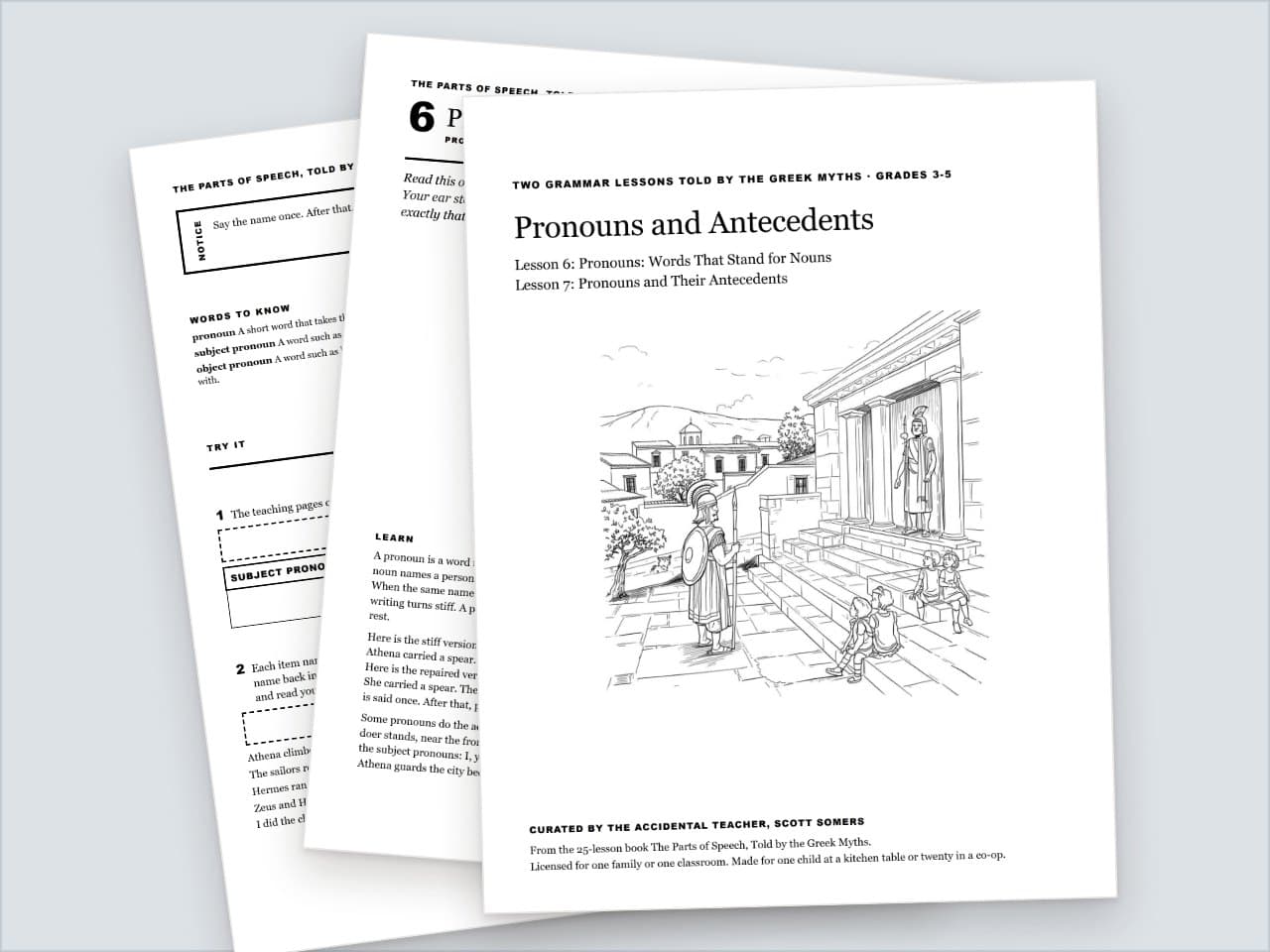
By the end of this
- Say the name once. After that, let a pronoun do the carrying.
- The arrow always points backward. Find the pronoun, then look back for the noun it stands for.
Your child is ready for this if they
- Read a short paragraph on their own and can say what it said
- Know that a sentence opens with a capital letter and closes with a mark
- Will write a sentence of their own rather than only fill in a blank
That list matters more than the age we printed on it. You know which of the two is true of your child.
A pronoun is a word that takes the place of a noun. A noun names a person, a place, a thing, or an idea. When the same name comes back line after line, the writing turns stiff. A pronoun steps in so the name can rest.
Here is the stiff version. Athena guarded the city. Athena carried a spear. The people thanked Athena. Here is the repaired version. Athena guarded the city. She carried a spear. The people thanked her. The name is said once. After that, pronouns do the work.
Some pronouns do the acting. They stand where the doer stands, near the front of the sentence. These are the subject pronouns: I, you, he, she, it, we, they. So Athena guards the city becomes She guards the city.
Other pronouns receive the action. They also sit right after a small word such as to, for, with, or at. These are the object pronouns: me, you, him, her, it, us, them. So The people thanked Athena becomes The people thanked her. And Hermes ran to the sailors becomes Hermes ran to them.
Here is how to choose. First ask what the name was doing: doing the action, or receiving it. A doer takes a word from the first list. A receiver takes a word from the second. Then put the name back in and read the sentence out loud, to be sure it still says what you meant. When a name is joined to another person, cover the other person and read your pronoun alone. Dad waved to Tim and me becomes Dad waved to me.
A pronoun stands in for a noun. The noun it stands for is its antecedent. The antecedent comes first, and the pronoun comes after it. Read this line: Arachne loved the loom, and she wove all day. The pronoun is she. The antecedent is Arachne. Draw an arrow from she back to Arachne. That arrow shows what the pronoun means.
A pronoun has to agree with its antecedent. Agree means match. They match in number first. One weaver takes she. Many weavers take they. Read both lines. The weaver sat down, and she picked up a thread. The weavers sat down, and they picked up a thread. A plural antecedent takes a plural pronoun. They match in kind too. A woman or a girl takes she. A man or a boy takes he. A thing takes it.
Here are the steps. Step one, find the pronoun. Step two, look back for the noun it points to. Step three, ask how many. Step four, check that the pronoun matches. Now work one. Athena wore a helmet, and it shone in the sun. The pronoun is it. Look back and find helmet. There is one helmet, and a helmet is a thing, so it matches. The arrow goes from it back to helmet.
Sometimes a sentence gives a pronoun two nouns to point back to. Then nobody can tell. Athena watched Arachne, and she smiled. Who smiled? Athena is a woman and Arachne is a girl, so both of them take she. The arrow could go two ways. That is an unclear pronoun. The repair is small. Take the pronoun out and put the name back in. Athena watched Arachne, and Arachne smiled. Now the sentence says one thing only.
You already fix this at home. Tell a friend this: Ella walked home with Mia, and she dropped the ball. Your friend will stop you and ask who dropped it. Put the name back in, and the question goes away. In the myth, the two weavers finished their cloth. Athena reached out, and Arachne became the first spider, still weaving.
What is inside
- 01Pronouns: Words That Stand for Nouns — the teaching page
- 02Pronouns: Words That Stand for Nouns — the work page, answerable from the teaching page
- 03Take it outside: Stand outside and tell somebody in your house about one thing you can see, using the full name of it three times in a row.
- 04Pronouns and Their Antecedents — the teaching page
- 05Pronouns and Their Antecedents — the work page, answerable from the teaching page
- 06Take it outside: Go outside and find two of the same kind of animal, like two birds on a wire or two dogs in a yard.
Standards alignment, for a portfolio or a state filing
4 alignments. Copy what your state asks for and ignore the rest — this is here for the paperwork, not for the teaching.
| Framework | Code | What it covers |
|---|---|---|
| CCSS | CCSS.ELA-LITERACY.L.3.1.A | |
| CCSS | CCSS.ELA-LITERACY.L.3.1.F | |
| CCSS | CCSS.ELA-LITERACY.L.6.1.A | |
| CCSS | CCSS.ELA-LITERACY.L.6.1.D |