Prepositions and Prepositional Phrases: Two Grammar Lessons, Grades 3-5
First the little word that shows position. Then the whole phrase, from that word to its object, lifted out so the sentence still stands.
By the end of this
- A preposition is a small word doing a big job. Drop a word into the gap in walked ___ the maze. If it fits and it changes where you end up, you are holding a preposition.
- Bracket the phrase, cross it out, and whatever is left standing is the real sentence. The subject never hides inside a prepositional phrase.
Your child is ready for this if they
- Read a short paragraph on their own and can say what it said
- Know that a sentence opens with a capital letter and closes with a mark
- Will write a sentence of their own rather than only fill in a blank
That list matters more than the age we printed on it. You know which of the two is true of your child.
A preposition is a small word that shows how one thing stands next to another. It can show where a thing is. It can show which way a thing moves. It can also show when something happens. Look at this sentence. The hero walked into the maze. The word into is a preposition. It tells you which way the hero went. Take that one small word out and the sentence falls apart.
Here is a test you can use. Take the small word away and leave a gap. The hero walked ___ the maze. Now try words in the gap and read each one out loud. He walked in the maze. He walked into the maze. He walked out of the maze. He walked through the maze. He walked around the maze. He walked past the maze. He walked toward the maze. Every one of those words fits the gap. Every one of them changes where the hero goes. That is the maze test. If a word fits that gap and changes where, the word is a preposition.
Prepositions do three jobs. The first job is position. Position means where a thing sits or stands next to something else. These words show position: in, on, under, over, beside, between, and behind. The owl sat on the wall. Nothing moved at all. The word on only told you where the owl was. The second job is direction. Direction means the way something moves. These words show direction: into, out of, through, toward, past, around, across, down, and to. The ship sailed across the sea. Something moved, and across told you which way. The third job is time. These words show time: before, after, during, and until. The gods met before the storm. That sentence says nothing about place. The word before tells you when.
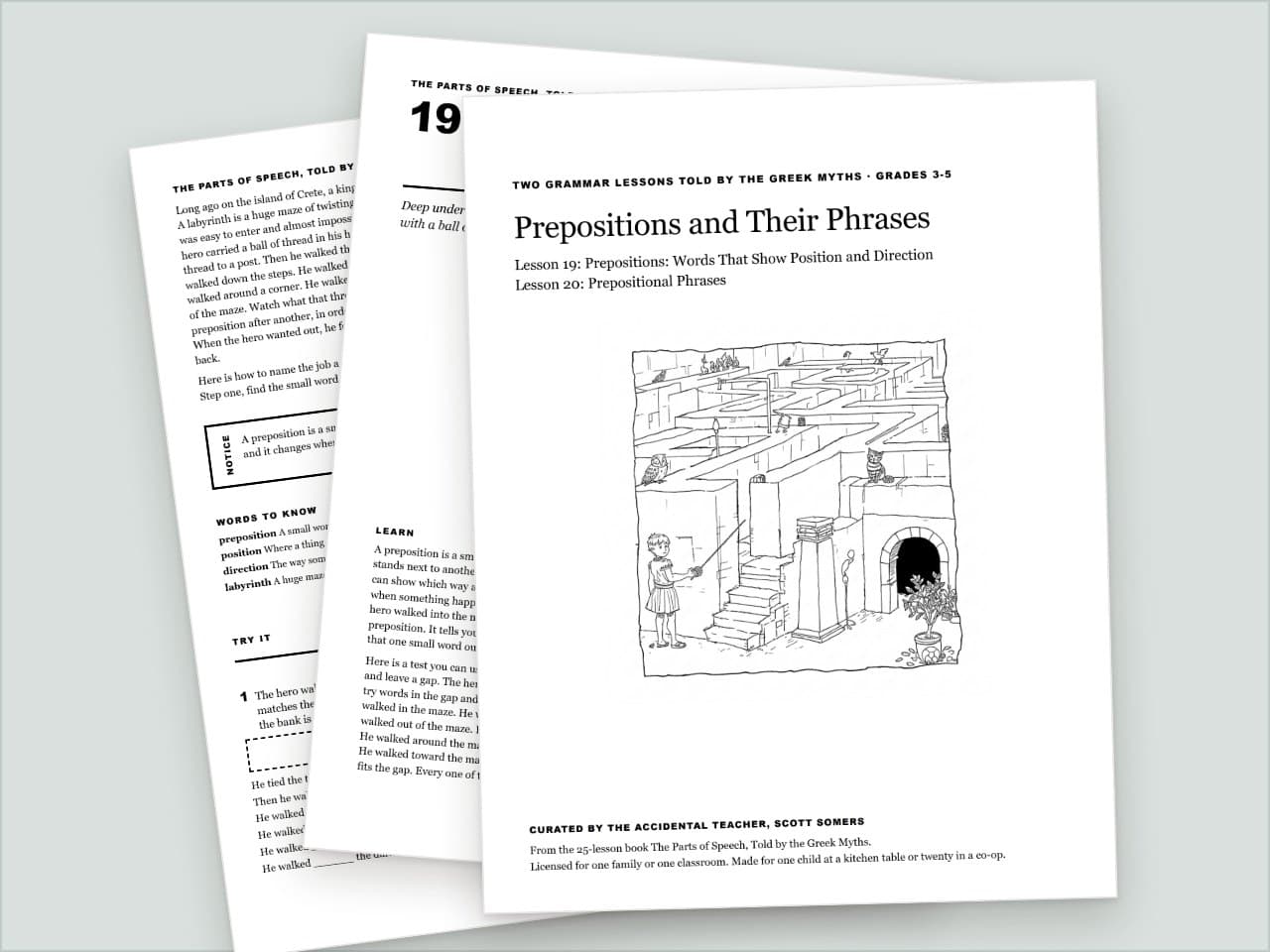
Long ago on the island of Crete, a king kept a labyrinth. A labyrinth is a huge maze of twisting stone halls. It was easy to enter and almost impossible to leave. A hero carried a ball of thread in his hand. He tied the thread to a post. Then he walked through the gate. He walked down the steps. He walked past a cold pool. He walked around a corner. He walked into the dark heart of the maze. Watch what that thread did. It traced one preposition after another, in order, all the way in. When the hero wanted out, he followed the thread back.
Here is how to name the job a preposition is doing. Step one, find the small word. Step two, ask if it tells where. Step three, if it tells where, ask if anything is moving. Nothing moving means position. Something moving means direction. Step four, if it does not tell where at all, ask if it tells when. If it tells when, the job is time. Now work one. We waited under the porch during the rain. The word under tells where, and nobody is moving, so under shows position. The word during does not tell where. It tells when, so during shows time. One last thing to hold on to. A preposition never stands alone. It always points at a noun a word or two after it, as in under the porch and during the rain.
A preposition is a small word that shows position, direction, or time. In. On. Under. Of. Past. By. Toward. At. Before. A few prepositions, like of, show belonging instead: the helmet of the god. A preposition never works alone. It reaches forward and grabs a noun or a pronoun. That noun is called the object of the preposition. The preposition, the object, and any words that sit between them make one team. That team is a prepositional phrase. In the sea. Under a bright moon. Of the gods. Every one opens with a preposition and closes on its object.
Draw a bracket around the whole phrase so you can see it as one piece. Three steps. Step one: find the preposition. Step two: slide your pencil to the right until you reach the first noun or pronoun. That word is the object. Step three: close the bracket right after that word. Watch it work. The temple stood on a high hill. Step one: the preposition is on. Step two: slide right past a and past high, and stop at hill. Step three: close. The temple stood [on a high hill]. The words a and high live inside the bracket because they sit between the preposition and its object. Work one more. The doves rested on the roof. The preposition is on. Slide right to roof. Close. The doves rested [on the roof].
Now the useful part. A prepositional phrase can be lifted out, and the sentence still stands on its own. Cross out the bracket and read what is left. The temple stood. That is still a whole sentence. Try another one. The helmet [of the god] shone. Cross out the phrase and read: The helmet shone. Still whole. A phrase adds detail. A phrase is almost never the bones of the sentence.
Here is why that matters. The subject is the word the sentence is about, the one the verb has to match. The subject is never inside a prepositional phrase. Never once. So when you cannot tell whether a verb should be is or are, bracket the phrases, cross them out, and the true subject is left standing alone. The chest [of golden apples] ___ heavy. Cross out the phrase. Now read: The chest ___ heavy. One chest, so the answer is is, even though apples sits right beside the gap. Turn it around. The apples [in the chest] ___ golden. Cross out the phrase. Now read: The apples ___ golden. More than one apple, so the answer is are.
One sentence can hold several phrases, and each one answers where or when. [At dawn] the ship sailed [past the island] [toward the mountain]. At dawn tells when. Past the island tells where, and so does toward the mountain. Bracket them one at a time, cross them all out, and the bare sentence appears: the ship sailed. You do this with your own things every day. The stack [of books] [on the desk] [by the window] is mine. Cross out all three brackets and only the stack is mine is left standing.
What is inside
- 01Prepositions: Words That Show Position and Direction — the teaching page
- 02Prepositions: Words That Show Position and Direction — the work page, answerable from the teaching page
- 03Take it outside: Go outside and stand still.
- 04Prepositional Phrases — the teaching page
- 05Prepositional Phrases — the work page, answerable from the teaching page
- 06Take it outside: Go outside and stand still.
Standards alignment, for a portfolio or a state filing
3 alignments. Copy what your state asks for and ignore the rest — this is here for the paperwork, not for the teaching.
| Framework | Code | What it covers |
|---|---|---|
| CCSS | CCSS.ELA-LITERACY.L.4.1.E | |
| CCSS | CCSS.ELA-LITERACY.L.5.1.A | |
| CCSS | CCSS.ELA-LITERACY.L.3.1.F |