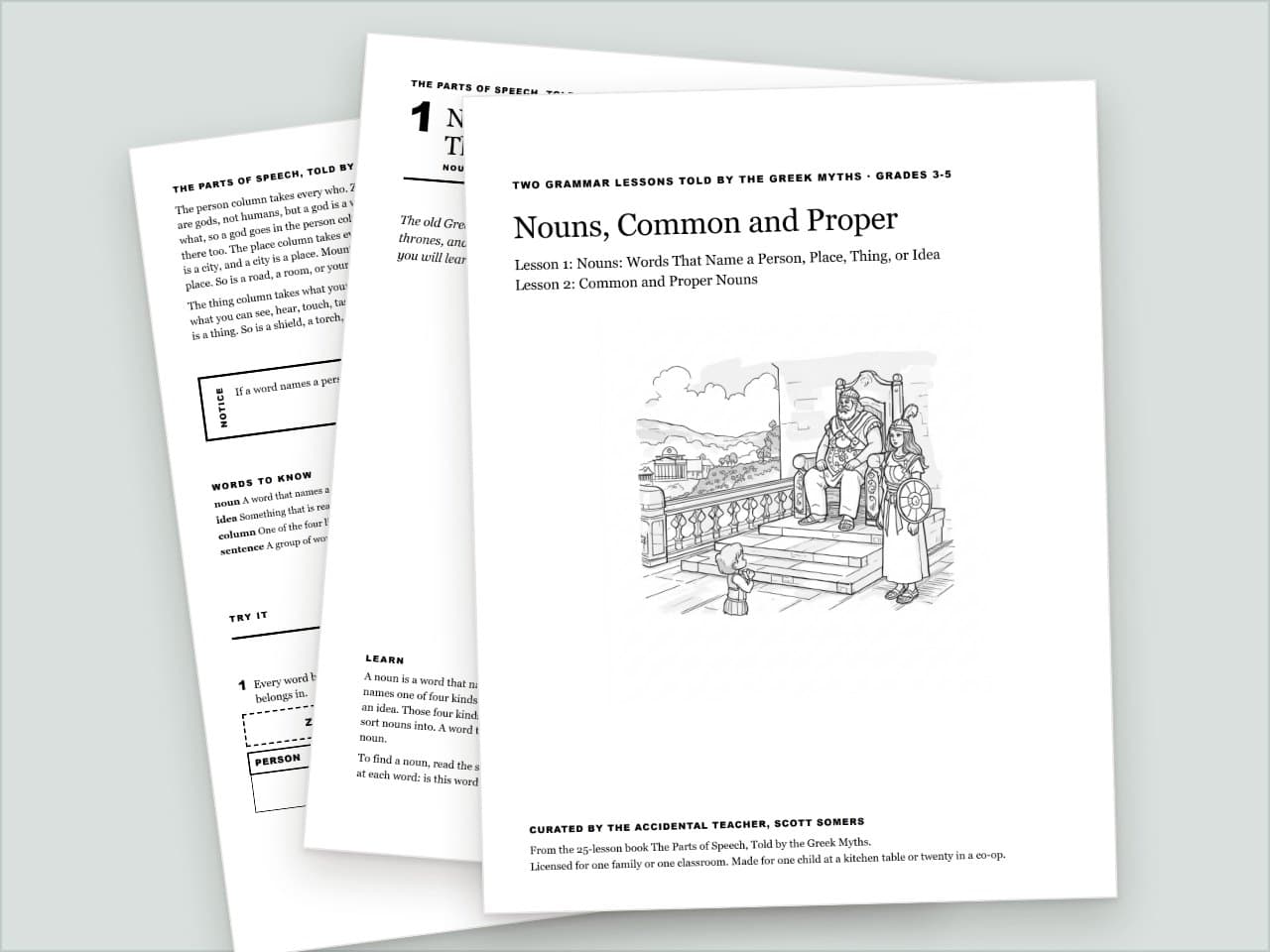
Nouns and Common Proper Nouns: Two Grammar Lessons, Grades 3-5
First a child learns what a noun is. Then the same child learns why Olympus is not the same kind of noun as mountain.
By the end of this
- If a word names a person, a place, a thing, or an idea, it is a noun. If it names nothing, it is not.
- A noun that names one certain one wears a capital letter, wherever it sits in the sentence.
Your child is ready for this if they
- Read a short paragraph on their own and can say what it said
- Know that a sentence opens with a capital letter and closes with a mark
- Will write a sentence of their own rather than only fill in a blank
That list matters more than the age we printed on it. You know which of the two is true of your child.
A noun is a word that names something. Every noun names one of four kinds: a person, a place, a thing, or an idea. Those four kinds are the four columns you will sort nouns into. A word that names nothing is not a noun.
To find a noun, read the sentence and ask one question at each word: is this word naming something? Try it on this sentence. Zeus sat on a gold throne on Mount Olympus. Zeus names a person, so Zeus is a noun. Throne names a thing, so throne is a noun. Mount Olympus names a place, so it is a noun too. Sat is not a noun, because sat tells what Zeus did. Gold is not a noun here, because gold tells what the throne is like. One sentence usually holds more than one noun.
The person column takes every who. Zeus and Athena are gods, not humans, but a god is a who and not a what, so a god goes in the person column. A hero goes there too. The place column takes every where. Athens is a city, and a city is a place. Mount Olympus is a place. So is a road, a room, or your own yard.
The thing column takes what your senses can reach: what you can see, hear, touch, taste, or smell. A throne is a thing. So is a shield, a torch, or an olive tree. The idea column takes what is real but no sense can reach. Courage, hope, fear, and honor are ideas. A hero shows courage, but nobody can hand you a box of it. An idea noun is still a noun, because it still names something.
Sorting proves your work. Write each noun you found under the column that fits it, and say why it fits. If a word will not sit in any of the four columns, look again, because it was probably not a noun at all.
A noun names a person, a place, a thing, or an idea. Nouns can also be sorted a second way, into two kinds. A common noun names any one of a group. The word mountain is a common noun. It fits every mountain on earth. So does the word city. So does the word river.
A proper noun names one certain one. Olympus is a proper noun. It names one mountain in Greece. In the old stories, the gods lived on top of it. A proper noun always begins with a capital letter. A common noun begins with a small letter, unless it starts a sentence.
Behind every proper noun stands a common noun. Behind Olympus stands the word mountain. Behind Athens stands the word city. Behind Styx stands the word river. The common noun tells what kind of thing it is. The proper noun tells which certain one.
Some words wait to be proper. The word king is a common noun. Greece had many kings. But when king moves in front of a name, it joins the name and takes a capital letter. King Midas is a proper noun. A word like king or queen, used in front of a name, is called a title. The word god is a common noun too, and it stays one even when it stands next to Zeus. Zeus is a proper noun. Place names have titles too. Mount works like a title: Mount Olympus.
Here is the test, in two steps. Step one, ask what the word names. Step two, ask if it names any one of a group or one certain one. Try the word ship. A ship is any ship, so ship is a common noun and stays small. Now try the Argo, the ship Jason sailed. Argo points at one certain boat, so it is proper and it needs a capital letter.
What is inside
- 01Nouns: Words That Name a Person, Place, Thing, or Idea — the teaching page
- 02Nouns: Words That Name a Person, Place, Thing, or Idea — the work page, answerable from the teaching page
- 03Take it outside: Step outside and stand still.
- 04Common and Proper Nouns — the teaching page
- 05Common and Proper Nouns — the work page, answerable from the teaching page
- 06Take it outside: Go outside and find five things.
Standards alignment, for a portfolio or a state filing
4 alignments. Copy what your state asks for and ignore the rest — this is here for the paperwork, not for the teaching.
| Framework | Code | What it covers |
|---|---|---|
| CCSS | CCSS.ELA-LITERACY.L.3.1.A | |
| CCSS | CCSS.ELA-LITERACY.L.1.1.B | |
| CCSS | CCSS.ELA-LITERACY.L.2.2.A | |
| CCSS | CCSS.ELA-LITERACY.L.4.1 |