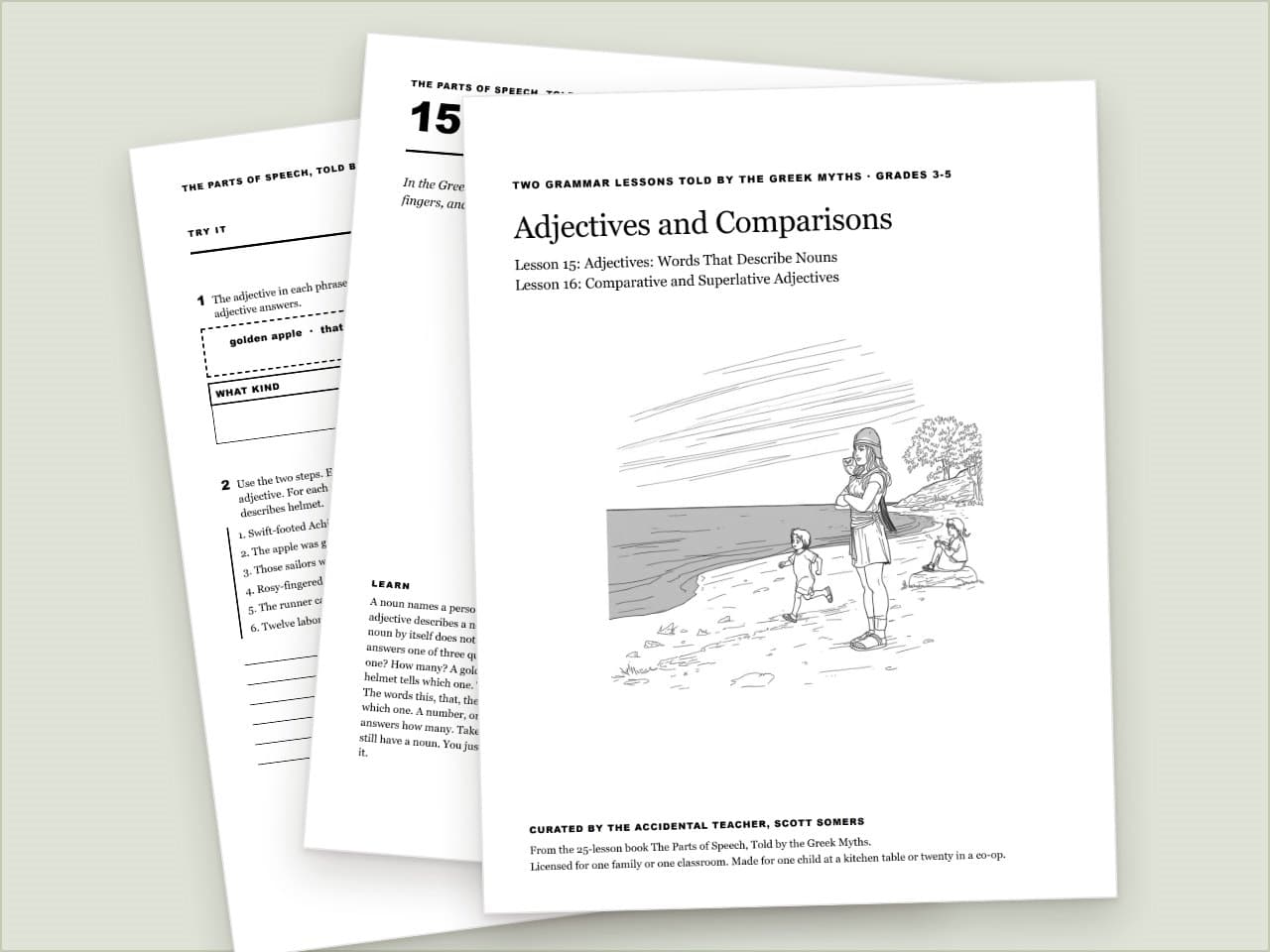
Adjectives and Comparatives: Two Grammar Lessons, Grades 3-5
First the exact word instead of nice. Then the form that compares two things without saying more swifter.
By the end of this
- An adjective is only worth writing if it hands the reader something.
- Two counts decide everything. Count the things to pick between er and est. Count the syllables to decide whether the adjective takes an ending at all, or takes more and most in front.
Your child is ready for this if they
- Read a short paragraph on their own and can say what it said
- Know that a sentence opens with a capital letter and closes with a mark
- Will write a sentence of their own rather than only fill in a blank
That list matters more than the age we printed on it. You know which of the two is true of your child.
A noun names a person, a place, a thing, or an idea. An adjective describes a noun. It tells you something the noun by itself does not tell you. Every adjective answers one of three questions. What kind? Which one? How many? A golden apple tells what kind. That helmet tells which one. Three sisters tells how many. The words this, that, these, and those always answer which one. A number, or a word like many, always answers how many. Take the adjective away and you still have a noun. You just do not know as much about it.
An adjective usually stands just in front of the noun it describes. Bronze shield. Wine-dark sea. Those sailors. Twelve labors. Many ships. So here is how to find one, in two steps. Step one: find the noun. Ask what is being named. Step two: look at the word sitting right in front of it. Skip the little words a, an, and the. They point at a noun, but on this sheet they are not the adjective we hunt. The word left is the adjective. An adjective can also sit after a linking verb, away from its noun. A linking verb is a form of be, such as is, was, or were. Read this sentence: The shield was bronze. The noun is shield. The adjective is bronze. It waited on the far side of was, and it still describes the shield.
Some adjectives hand a reader almost nothing. Nice. Big. Good. Fine. These are vague adjectives. A vague adjective sounds like it is doing work, but it leaves the reader with no picture at all. Say a nice sea and nobody sees anything. An exact adjective is different. It gives the reader one clear picture. Say a wine-dark sea and the reader sees deep red water at dusk. You can swap a vague adjective for an exact one in two moves. First, ask what you actually saw. Second, write that word instead. A nice shield becomes a bronze shield. A big apple becomes a golden apple.
Long ago a poet named Homer told some of the oldest Greek stories out loud. He did something clever with adjectives. He glued one to a name and then used it every single time. Gray-eyed Athena. Rosy-fingered dawn. Wine-dark sea. A permanent adjective like that is called an epithet. Look: not one of them is vague. Gray-eyed hands you the color of her eyes. Rosy-fingered hands you the pink light spreading over the sky at sunrise. Homer could have said nice dawn. He did not.
You already do this at home. Tell a friend you got a nice bike and your friend sees nothing. Tell your friend you got a red bike with fat tires, and it is right there. That is the whole job. An adjective hands somebody a picture without a picture. The same trick works on a person: Swift-footed Achilles is the runner nobody could catch. Pick the exact word, and your reader is standing where you stood.
An adjective describes a noun. When an adjective compares one thing to another, it changes shape. There are two shapes, and the count of things decides which one you need. The comparative shape compares exactly two things. Ares is strong, but Zeus is stronger. That is two gods, so the word is stronger. The superlative shape compares three or more things. Line up all twelve gods on Mount Olympus, and Zeus is the strongest. That is more than two, so the word is strongest. The word than goes with the er or more form. The words of all go with est or most.
Short adjectives take an ending. Add er for the comparative. Add est for the superlative. Swift becomes swifter and swiftest. Tall becomes taller and tallest. Loud becomes louder and loudest. Two spellings shift a little. If the adjective ends in a consonant and then y, change the y to i first. Mighty becomes mightier and mightiest. Angry becomes angrier and angriest. If the adjective already ends in e, just add r or st. Brave becomes braver and bravest.
Long adjectives do not take an ending. The ending sounds wrong in your mouth. Nobody says dangerousest. A long adjective puts a whole word in front instead. Put more in front for the comparative. Put most in front for the superlative. Dangerous becomes more dangerous and most dangerous. Famous becomes more famous and most famous. Terrible becomes more terrible and most terrible.
Here is how to choose, step by step. Step one, count the things being compared. Two means comparative. Three or more means superlative. Step two, say the adjective out loud and count its syllables. A syllable is one beat of sound. Step three, one syllable takes er or est. Step four, two syllables ending in y also take er or est. Step five, two syllables not ending in y, and anything longer, take more or most in front. Now work one. The adjective is powerful. Say it out loud: pow er ful. That is three syllables, so it is too long for an ending. It takes more and most. Two gods gives more powerful. All twelve gods gives most powerful.
A few adjectives are irregular. They refuse the whole system and turn into different words. Good becomes better and best. Bad becomes worse and worst. Far becomes farther and farthest. Hermes had better sandals than any other god, and the road to the underworld is the farthest road of all. One rule is left, and it is the one people break out loud every day. Choose one way or the other, and never use both. More stronger is wrong. Most swiftest is wrong. If the word already carries er or est, then more and most are not allowed in front of it. You hear the mistake on the playground when someone says his bike is more faster than yours. Say faster, and stop there.
What is inside
- 01Adjectives: Words That Describe Nouns — the teaching page
- 02Adjectives: Words That Describe Nouns — the work page, answerable from the teaching page
- 03Take it outside: Go outside and stand still until you find one thing worth describing: a tree, a bird, a truck, a stretch of sky.
- 04Comparative and Superlative Adjectives — the teaching page
- 05Comparative and Superlative Adjectives — the work page, answerable from the teaching page
- 06Take it outside: Go outside and find three of the same thing: three trees, three stones, or three puddles.
Standards alignment, for a portfolio or a state filing
4 alignments. Copy what your state asks for and ignore the rest — this is here for the paperwork, not for the teaching.
| Framework | Code | What it covers |
|---|---|---|
| CCSS | CCSS.ELA-LITERACY.L.3.1.G | |
| CCSS | CCSS.ELA-LITERACY.L.3.3.A | |
| CCSS | CCSS.ELA-LITERACY.L.4.3.A | |
| CCSS | CCSS.ELA-LITERACY.L.3.1.A |