Adverbs Worksheet: How When and Where, Greek Myths, Grades 3-5
A boy once drove the chariot that pulls the sun. The horses ran too fast, wildly, downward. Almost every word that tells you what that ride was like is an adverb.
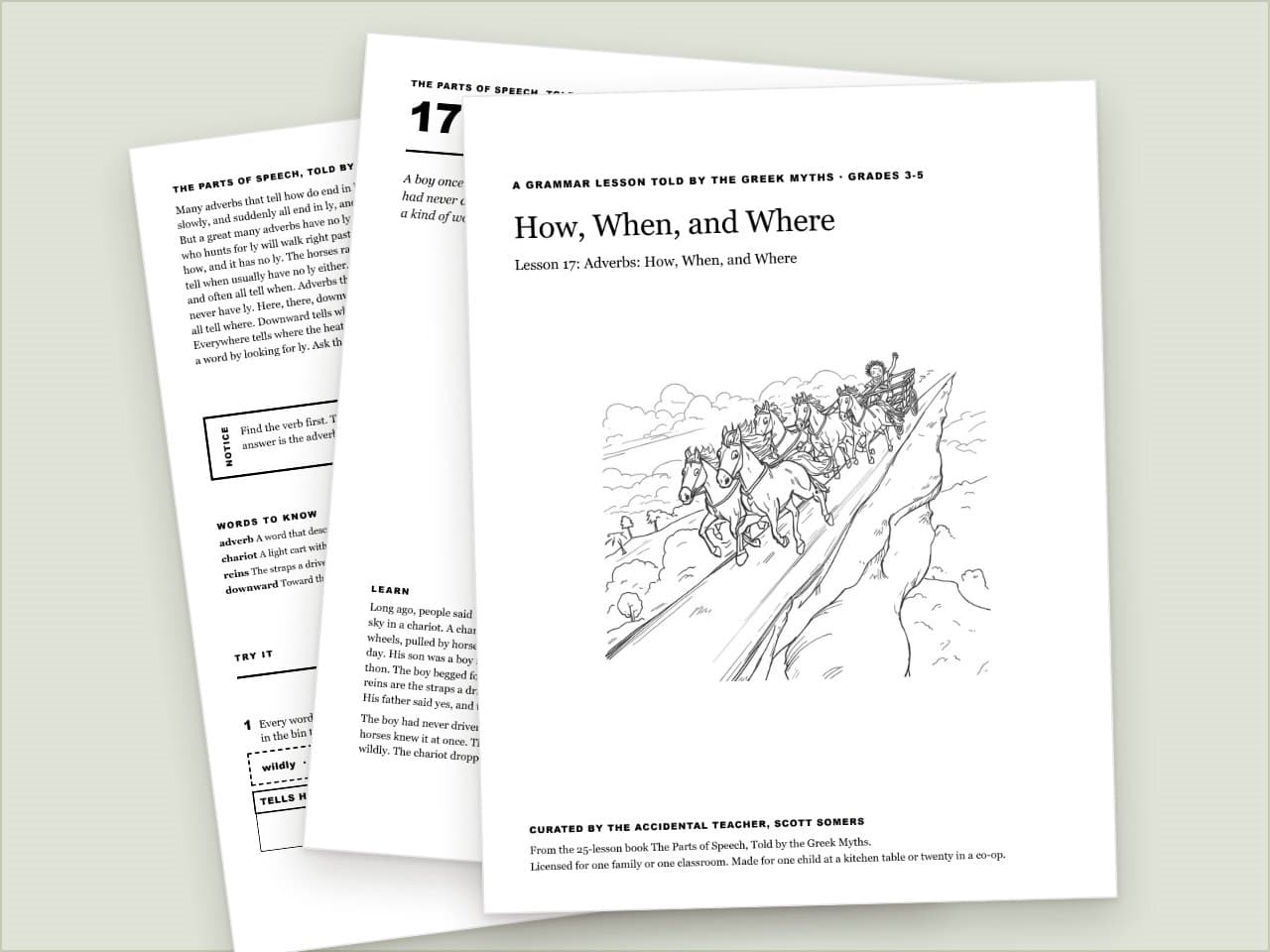
By the end of this
- Find the verb first. Then ask how, when, and where about it. Whichever question gets an answer, that answer is the adverb, and the word does not have to end in ly.
Your child is ready for this if they
- Read a short paragraph on their own and can say what it said
- Know that a sentence opens with a capital letter and closes with a mark
- Will write a sentence of their own rather than only fill in a blank
That list matters more than the age we printed on it. You know which of the two is true of your child.
Long ago, people said the sun was carried across the sky in a chariot. A chariot is a light cart with two wheels, pulled by horses. The sun god drove it every day. His son was a boy named Phaethon, said FAY uh thon. The boy begged for one turn at the reins. The reins are the straps a driver holds to steer the horses. His father said yes, and then wished he had not.
The boy had never driven the chariot before. The horses knew it at once. They ran too fast. They ran wildly. The chariot dropped downward toward the ground. Almost every word that tells you what that ride was like is the same kind of word. It is called an adverb. An adverb describes a verb. It answers one of three questions about the action. How? When? Where?
Here is how to find one. First find the verb, because the verb is the action. Then ask those three questions about it. Whichever question gets an answer, that answer is the adverb. Try it. The horses ran wildly. The verb is ran. How did they run? Wildly. So wildly is the adverb, and it tells how. Try one more. The horses soon left the road in the sky. The verb is left. When did they leave? Soon. So soon is the adverb, and it tells when.
Many adverbs that tell how do end in ly. Wildly, badly, slowly, and suddenly all end in ly, and all four tell how. But a great many adverbs have no ly at all, and a child who hunts for ly will walk right past them. Fast tells how, and it has no ly. The horses ran fast. Adverbs that tell when usually have no ly either. Soon, then, never, and often all tell when. Adverbs that tell where almost never have ly. Here, there, downward, and everywhere all tell where. Downward tells where the chariot went. Everywhere tells where the heat spread. So do not test a word by looking for ly. Ask the question instead.
An adverb can often move. Put it in a different spot in the sentence, and the sentence still means what it meant. Suddenly the chariot dropped. The chariot suddenly dropped. The chariot dropped suddenly. All three sentences say the same thing. That is a handy test. If a word can slide around the verb and nothing changes, you are probably holding an adverb. The ride ended when the king of the gods knocked the chariot out of the sky with a thunderbolt, and the boy never drove again. Read the whole story back and you will find it is told almost entirely in adverbs: too fast, wildly, downward.
What is inside
- 01Adverbs: How, When, and Where — the teaching page
- 02Adverbs: How, When, and Where — the work page, answerable from the teaching page
- 03Take it outside: Go outside and do one thing on purpose, such as running to a fence, climbing a step, or throwing a ball.
Standards alignment, for a portfolio or a state filing
1 alignments. Copy what your state asks for and ignore the rest — this is here for the paperwork, not for the teaching.
| Framework | Code | What it covers |
|---|---|---|
| CCSS | CCSS.ELA-LITERACY.L.3.1.A |