Adjectives Worksheet: Words That Describe Nouns, Greek Myths, Grades 3-5
In the old stories the sea is never simply the sea. It is the wine-dark sea. This sheet is the kind of word that does that work, and why nice sea hands a reader nothing.
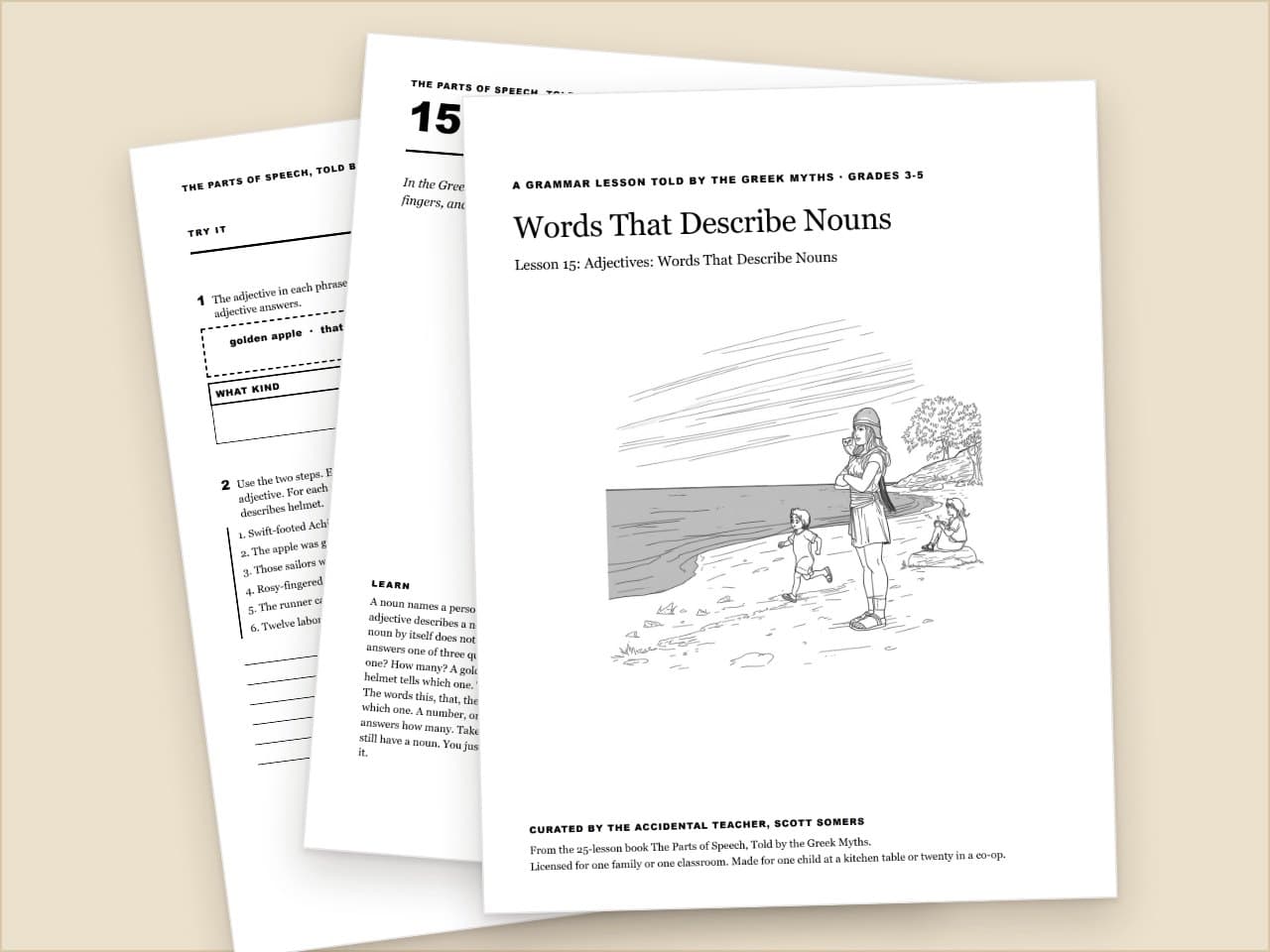
By the end of this
- An adjective is only worth writing if it hands the reader something.
Your child is ready for this if they
- Read a short paragraph on their own and can say what it said
- Know that a sentence opens with a capital letter and closes with a mark
- Will write a sentence of their own rather than only fill in a blank
That list matters more than the age we printed on it. You know which of the two is true of your child.
A noun names a person, a place, a thing, or an idea. An adjective describes a noun. It tells you something the noun by itself does not tell you. Every adjective answers one of three questions. What kind? Which one? How many? A golden apple tells what kind. That helmet tells which one. Three sisters tells how many. The words this, that, these, and those always answer which one. A number, or a word like many, always answers how many. Take the adjective away and you still have a noun. You just do not know as much about it.
An adjective usually stands just in front of the noun it describes. Bronze shield. Wine-dark sea. Those sailors. Twelve labors. Many ships. So here is how to find one, in two steps. Step one: find the noun. Ask what is being named. Step two: look at the word sitting right in front of it. Skip the little words a, an, and the. They point at a noun, but on this sheet they are not the adjective we hunt. The word left is the adjective. An adjective can also sit after a linking verb, away from its noun. A linking verb is a form of be, such as is, was, or were. Read this sentence: The shield was bronze. The noun is shield. The adjective is bronze. It waited on the far side of was, and it still describes the shield.
Some adjectives hand a reader almost nothing. Nice. Big. Good. Fine. These are vague adjectives. A vague adjective sounds like it is doing work, but it leaves the reader with no picture at all. Say a nice sea and nobody sees anything. An exact adjective is different. It gives the reader one clear picture. Say a wine-dark sea and the reader sees deep red water at dusk. You can swap a vague adjective for an exact one in two moves. First, ask what you actually saw. Second, write that word instead. A nice shield becomes a bronze shield. A big apple becomes a golden apple.
Long ago a poet named Homer told some of the oldest Greek stories out loud. He did something clever with adjectives. He glued one to a name and then used it every single time. Gray-eyed Athena. Rosy-fingered dawn. Wine-dark sea. A permanent adjective like that is called an epithet. Look: not one of them is vague. Gray-eyed hands you the color of her eyes. Rosy-fingered hands you the pink light spreading over the sky at sunrise. Homer could have said nice dawn. He did not.
You already do this at home. Tell a friend you got a nice bike and your friend sees nothing. Tell your friend you got a red bike with fat tires, and it is right there. That is the whole job. An adjective hands somebody a picture without a picture. The same trick works on a person: Swift-footed Achilles is the runner nobody could catch. Pick the exact word, and your reader is standing where you stood.
What is inside
- 01Adjectives: Words That Describe Nouns — the teaching page
- 02Adjectives: Words That Describe Nouns — the work page, answerable from the teaching page
- 03Take it outside: Go outside and stand still until you find one thing worth describing: a tree, a bird, a truck, a stretch of sky.
Standards alignment, for a portfolio or a state filing
3 alignments. Copy what your state asks for and ignore the rest — this is here for the paperwork, not for the teaching.
| Framework | Code | What it covers |
|---|---|---|
| CCSS | CCSS.ELA-LITERACY.L.3.3.A | |
| CCSS | CCSS.ELA-LITERACY.L.4.3.A | |
| CCSS | CCSS.ELA-LITERACY.L.3.1.A |