Photosynthesis and How a Tree Drinks: Two Wren and Sitka Lessons, Grades 3-5
One sheet on how a leaf turns light into food, one on how a tall tree lifts water a hundred feet with no pump and no moving parts. Both are things adults use every day without being able to explain.
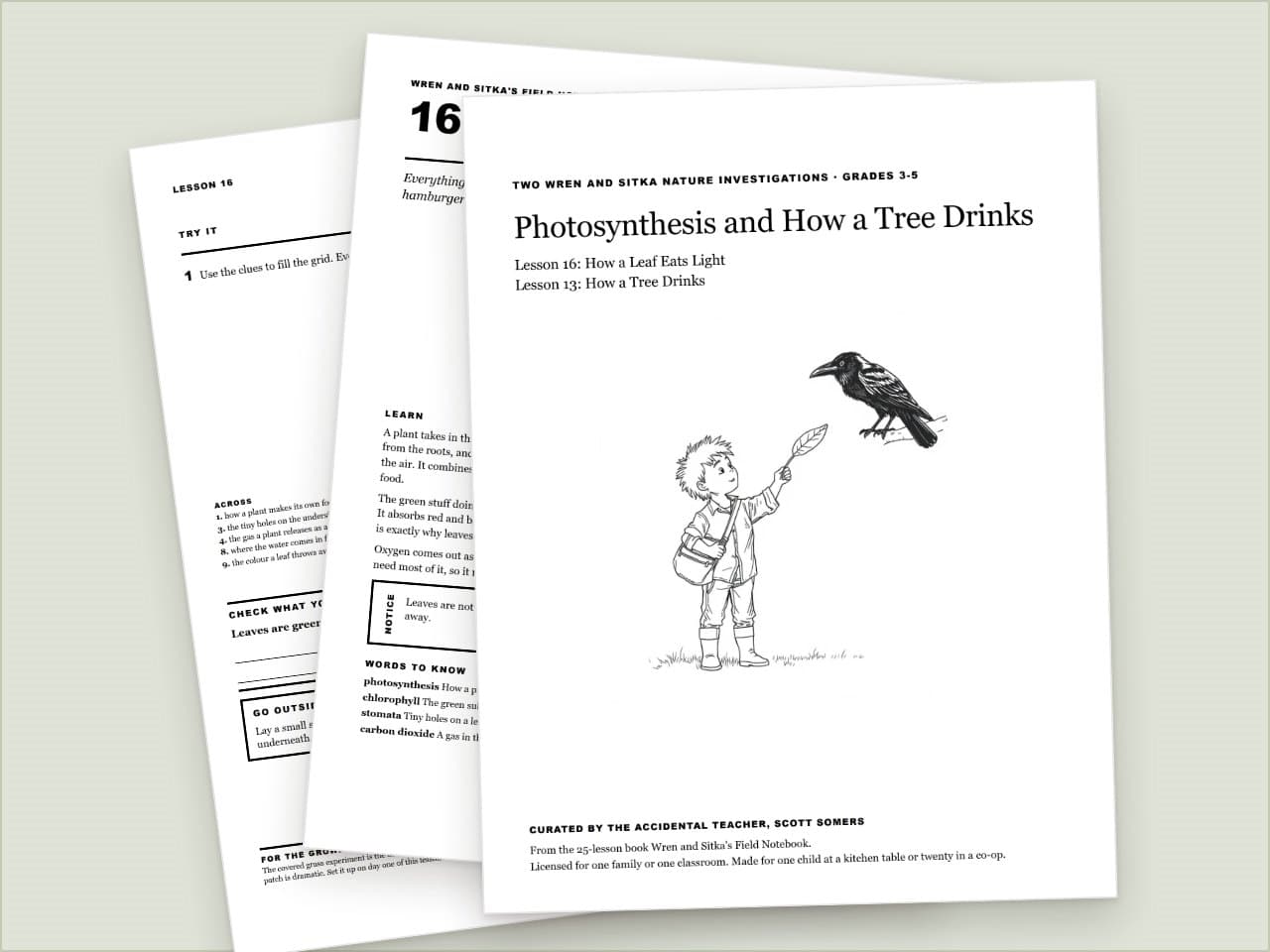
By the end of this
- Your child can explain what a leaf's green colour tells you about the sunlight it uses
- Your child can explain what actually lifts water to the top of a tall tree, with no pump involved
Your child is ready for this if they
- Reads a short paragraph without help
- Writes a sentence in their own words
- Will go outside and look at something for five minutes
That list matters more than the age we printed on it. You know which of the two is true of your child.
A plant takes in three things: light from the sun, water from the roots, and a gas called carbon dioxide from the air. It combines them and makes sugar, which is food.
The green stuff doing the catching is called chlorophyll. It absorbs red and blue light and reflects green, which is exactly why leaves look green to you.
Oxygen comes out as a leftover. The plant does not need most of it, so it releases it. Every breath you take is a plant's spare parts.
The gas goes in and out through tiny holes on the underside of the leaf called stomata. They open and close, which lets the plant control how much water it loses.
In autumn, many trees stop making chlorophyll. The green fades and the yellows and oranges that were there the whole time finally show.
Roots do two jobs. They hold the tree down, and they pull in water and minerals from the soil. Most of the important root work happens in fine hairlike roots near the surface, not in the big anchoring ones.
The trunk is not one solid thing. Just under the bark is a thin layer that carries food down from the leaves. Deeper in is wood that carries water up. Most of the middle of a big tree is dead wood doing structural work only.
Leaves are the food factory and also the reason the water moves. Water evaporates out of tiny holes in the leaves, and as each molecule leaves it tugs the one behind it. Water sticks to itself, so the whole column gets pulled upward.
That process is called transpiration, and it is doing the lifting. The tree spends no energy pulling water up. Evaporation does the work for free.
What is inside
- 01How a Leaf Eats Light — the teaching page
- 02How a Leaf Eats Light — the work page, answerable from the teaching page
- 03Take it outside: Lay a small stone or a piece of cardboard flat on a patch of grass.
- 04How a Tree Drinks — the teaching page
- 05How a Tree Drinks — the work page, answerable from the teaching page
- 06Take it outside: Put a clear plastic bag loosely over a leafy branch and tie it at the stem.
Standards alignment, for a portfolio or a state filing
3 alignments. Copy what your state asks for and ignore the rest — this is here for the paperwork, not for the teaching.
| Framework | Code | What it covers |
|---|---|---|
| NGSS | 5-LS1-1 | |
| NGSS | 5-PS3-1 | |
| NGSS | 4-LS1-1 |