Moon Phases: Why the Moon Changes Shape, a Wren and Sitka Lesson, Grades 3-6
The moon is not changing shape, and it is not the Earth's shadow doing it either. Almost every adult gets this one wrong. Phases are about your viewing angle, and Earth's shadow only touches the moon during an eclipse.
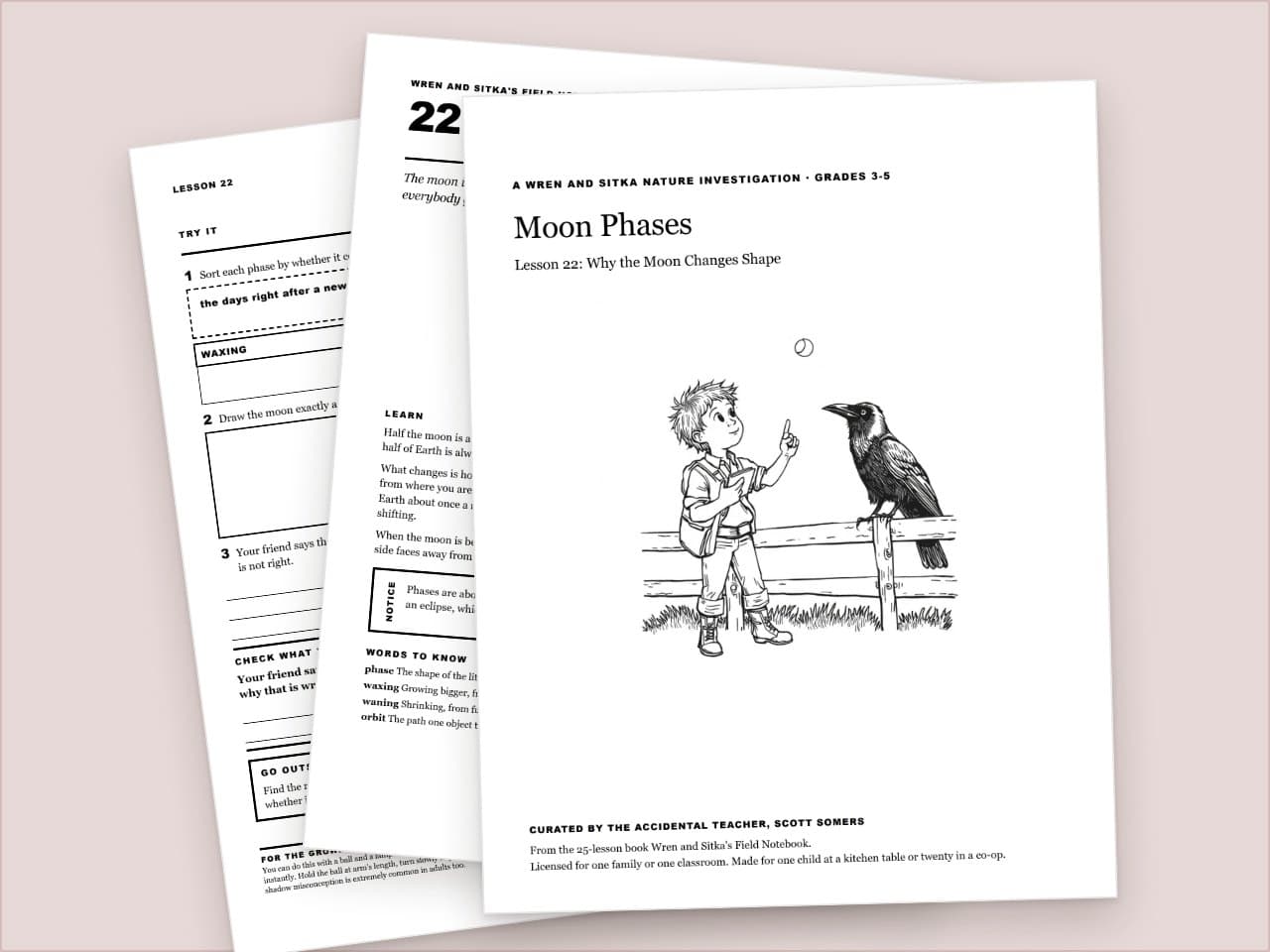
By the end of this
- Your child can explain why the moon changes shape, and why it is not the Earth's shadow
Your child is ready for this if they
- Reads a short paragraph without help
- Writes a sentence in their own words
- Will go outside and look at something for five minutes
That list matters more than the age we printed on it. You know which of the two is true of your child.
Half the moon is always lit by the sun, the same way half of Earth is always in daytime. That never changes.
What changes is how much of the lit half you can see from where you are standing. The moon travels around Earth about once a month, so your viewing angle keeps shifting.
When the moon is between Earth and the sun, the lit side faces away from us and we see almost nothing. That is a new moon. When Earth is between them, we see the whole lit face, which is a full moon.
In between you get crescents, half moons, and the fat shapes called gibbous.
Waxing means growing and it happens after a new moon. Waning means shrinking and it happens after a full moon. An eclipse is the shadow event, and it is rare and separate from all of this.
What is inside
- 01Why the Moon Changes Shape — the teaching page
- 02Why the Moon Changes Shape — the work page, answerable from the teaching page
- 03Take it outside: Find the moon tonight and draw its shape.
Standards alignment, for a portfolio or a state filing
2 alignments. Copy what your state asks for and ignore the rest — this is here for the paperwork, not for the teaching.
| Framework | Code | What it covers |
|---|---|---|
| NGSS | 5-ESS1-2 | |
| NGSS | MS-ESS1-1 |