Living and Nonliving Things: Wren and Sitka Nature Investigation, Grades 3-5
A candle flame grows, moves, uses energy, and gives off waste. So does a river. Neither one is alive, and most worksheets on this topic cannot tell your child why. This one can, because it works from the whole list of jobs a living thing does rather than from one or two.
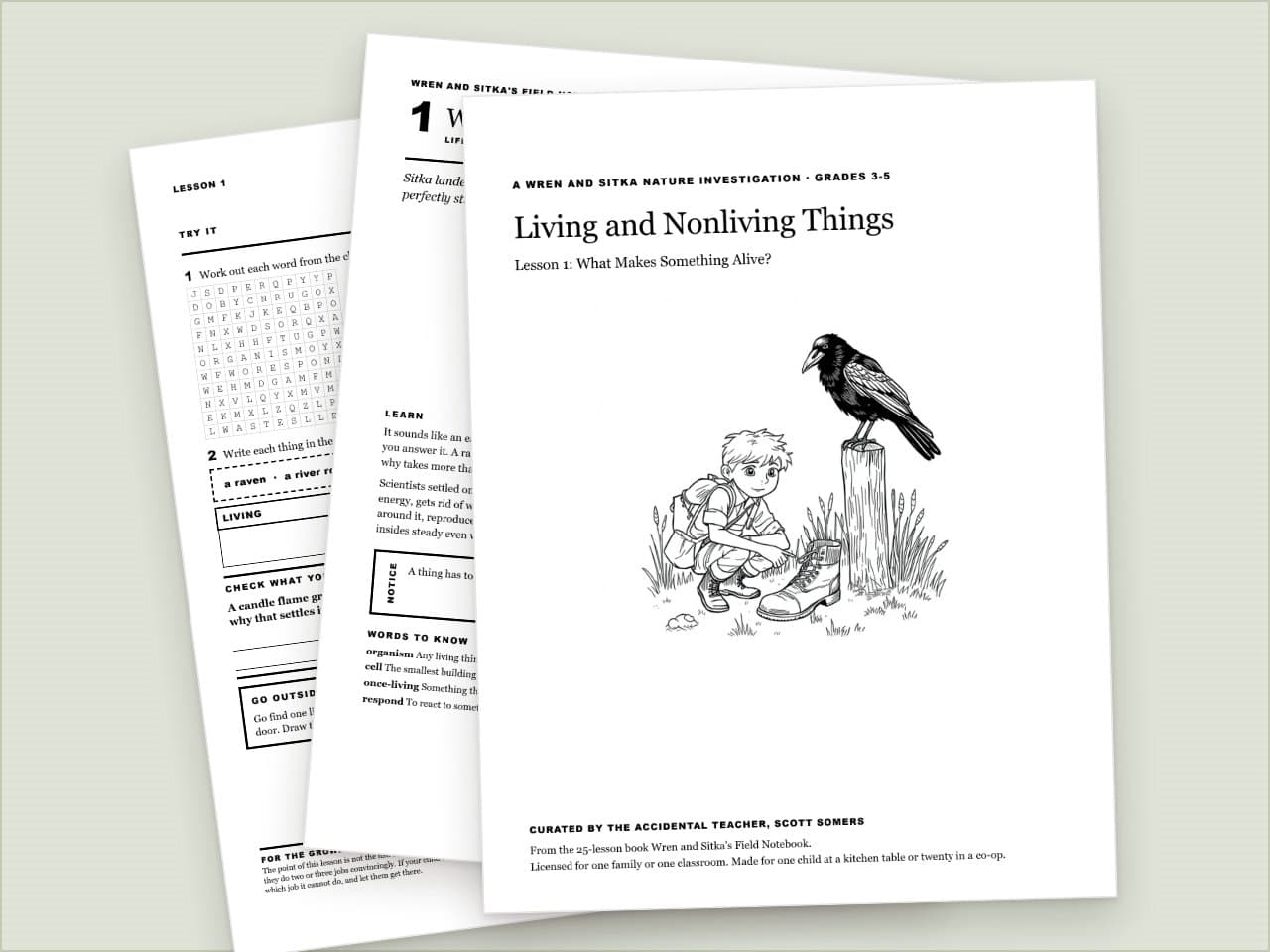
By the end of this
- Your child can say why a candle flame and a river are not alive, using the whole list of jobs a living thing does
Your child is ready for this if they
- Reads a short paragraph without help
- Writes a sentence in their own words
- Will go outside and look at something for five minutes
That list matters more than the age we printed on it. You know which of the two is true of your child.
It sounds like an easy question until somebody makes you answer it. A raven is alive. A boot is not. But saying why takes more than pointing.
Scientists settled on a list. A living thing grows, uses energy, gets rid of waste, responds to what happens around it, reproduces, is made of cells, and keeps its insides steady even when the weather changes.
Here is the tricky part. A thing has to do all of them. A river moves and changes, but it never eats and it never has baby rivers. A candle flame uses energy and grows, but it is not made of cells.
Some things used to be alive and are not anymore. A fallen log, a feather, a dry leaf. Scientists call those things once-living, and they are their own category.
What is inside
- 01What Makes Something Alive? — the teaching page
- 02What Makes Something Alive? — the work page, answerable from the teaching page
- 03Take it outside: Go find one living thing, one once-living thing, and one thing that was never alive, all within twenty steps of your door.
Standards alignment, for a portfolio or a state filing
3 alignments. Copy what your state asks for and ignore the rest — this is here for the paperwork, not for the teaching.
| Framework | Code | What it covers |
|---|---|---|
| NGSS | 5-LS2-1 | |
| NGSS | K-LS1-1 | |
| CCSS-ELA | RI.4.1 |