Food Chains and Food Webs: Two Wren and Sitka Nature Lessons, Grades 3-5
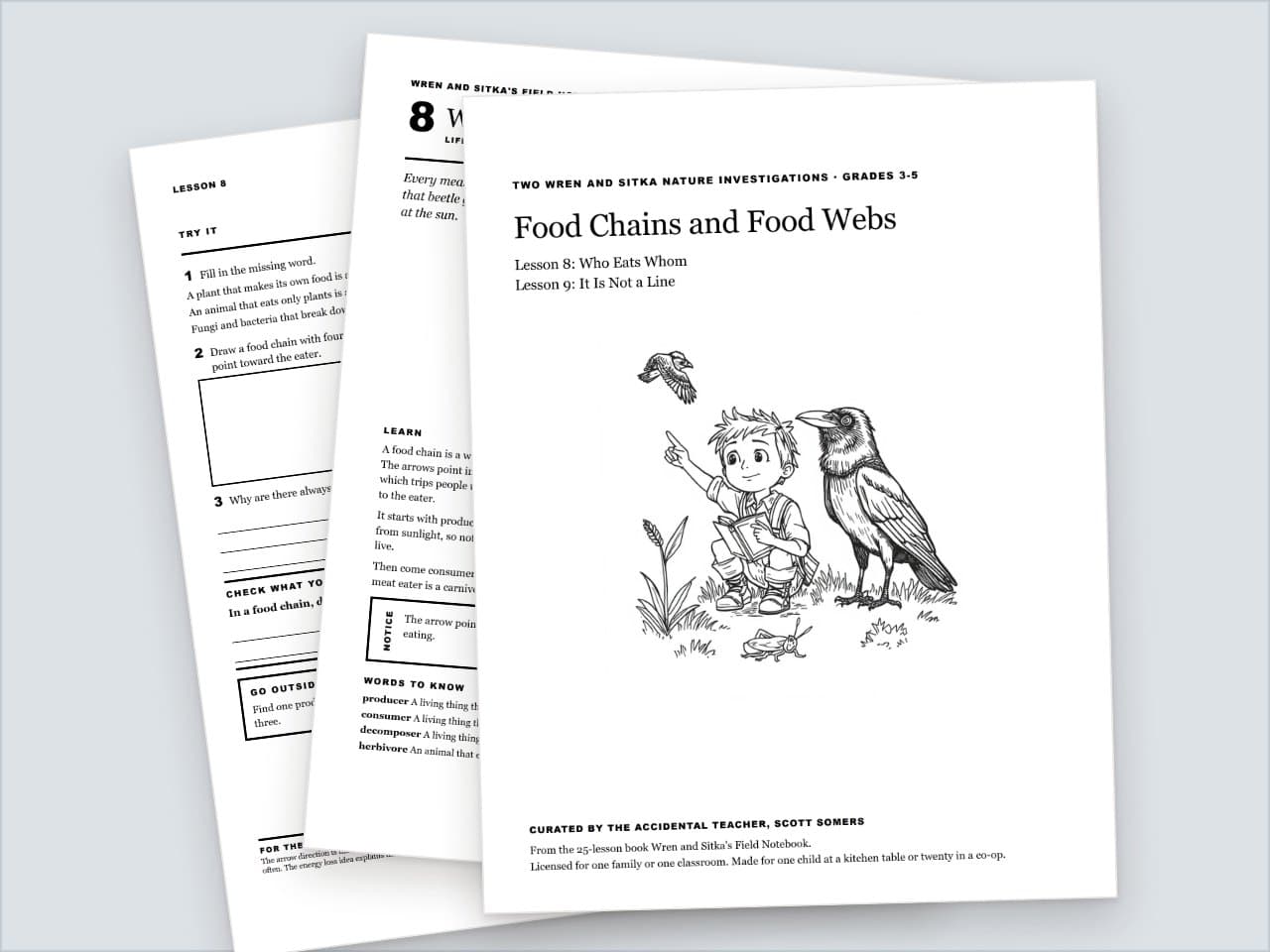
A food chain is a useful lie. Nothing in nature eats only one thing. The first sheet teaches the chain properly, arrows and all, and the second pulls it apart into the web where the truth lives.
By the end of this
- Your child can draw a food chain with the arrows pointing the right way, and say why they point at the eater
- Your child can explain why a picky eater is in more trouble than a generalist when one food disappears
Your child is ready for this if they
- Reads a short paragraph without help
- Writes a sentence in their own words
- Will go outside and look at something for five minutes
That list matters more than the age we printed on it. You know which of the two is true of your child.
A food chain is a way of drawing where energy goes. The arrows point in the direction the energy travels, which trips people up. The arrow goes from the eaten to the eater.
It starts with producers. Plants make their own food from sunlight, so nothing had to be eaten for them to live.
Then come consumers. A plant eater is a herbivore. A meat eater is a carnivore. An animal that eats both is an omnivore.
At the end come decomposers. Fungi, bacteria, and some insects break down what is left and return it to the soil, where plants use it again.
Energy is lost at every step, mostly as heat. That is why there are always far more plants than plant eaters, and far more plant eaters than predators.
Real animals have options. A fox eats mice, but also berries, birds, eggs, and beetles. Draw every one of those arrows and the neat chain becomes a tangle.
That tangle is a food web, and it is the honest picture. Most animals appear in several chains at the same time.
Webs matter because they explain what happens when something goes wrong. If one food disappears, an animal with many options shifts to another. An animal with only one option is in trouble.
Scientists call a species that holds a whole web together a keystone species. Remove it and far more collapses than you would expect from one animal.
What is inside
- 01Who Eats Whom — the teaching page
- 02Who Eats Whom — the work page, answerable from the teaching page
- 03Take it outside: Find one producer, one consumer, and one decomposer within sight of each other.
- 04It Is Not a Line — the teaching page
- 05It Is Not a Line — the work page, answerable from the teaching page
- 06Take it outside: Pick one animal you have actually seen near your home and list every single thing you think it might eat.
Standards alignment, for a portfolio or a state filing
2 alignments. Copy what your state asks for and ignore the rest — this is here for the paperwork, not for the teaching.
| Framework | Code | What it covers |
|---|---|---|
| NGSS | 5-LS2-1 | |
| NGSS | 5-PS3-1 |