Butterfly Life Cycle and Seed Dispersal: Two Wren and Sitka Lessons, Grades 3-5
Two lessons about getting somewhere. A caterpillar that comes apart in a case and rebuilds as something that eats entirely different food, and a plant that cannot walk but gets its children onto mountains and across rivers anyway.
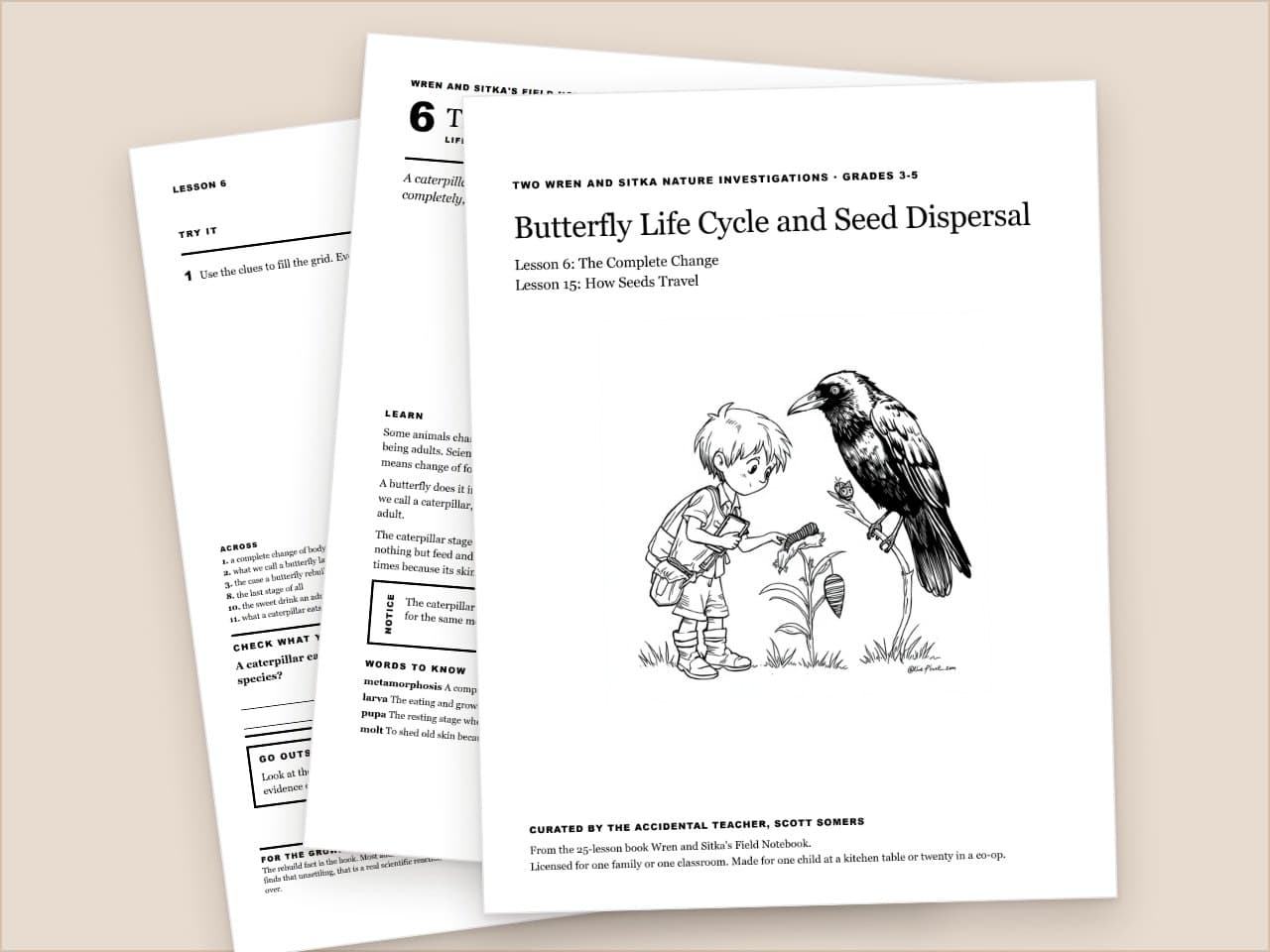
By the end of this
- Your child can name the four stages of complete metamorphosis and say why the caterpillar and butterfly eat different food
- Your child can explain what a plant gets in return for the energy it spends making sweet fruit
Your child is ready for this if they
- Reads a short paragraph without help
- Writes a sentence in their own words
- Will go outside and look at something for five minutes
That list matters more than the age we printed on it. You know which of the two is true of your child.
Some animals change shape completely on the way to being adults. Scientists call it metamorphosis, which means change of form.
A butterfly does it in four stages. Egg, then larva which we call a caterpillar, then pupa inside a chrysalis, then adult.
The caterpillar stage is the eating stage. It does almost nothing but feed and grow, shedding its skin several times because its skin does not stretch.
Inside the chrysalis, most of the caterpillar breaks down into a kind of soup, and special cells that were there all along build the butterfly. The adult that comes out has a completely different mouth, different legs, and eats completely different food.
Not every insect does this. A grasshopper hatches looking like a small grasshopper and just gets bigger. That is called incomplete metamorphosis.
A seed that falls straight down lands in its parent's shadow and competes with it for light and water. Moving away is worth a great deal, and plants have remarkable adaptations for sending seeds off.
Wind is the classic. Maple seeds spin like helicopter blades. Dandelion and milkweed seeds carry parachutes of fine hairs.
Animals do the rest. Some seeds hitch a ride with hooks and barbs that catch fur and socks. Others hide inside fruit, which an animal eats and then deposits somewhere else, already packaged in fertilizer.
Water carries seeds down streams and across oceans. A coconut can float for months.
A few plants fire their seeds. Touch a ripe jewelweed pod and it snaps open and flings them several feet.
What is inside
- 01The Complete Change — the teaching page
- 02The Complete Change — the work page, answerable from the teaching page
- 03Take it outside: Look at the underside of leaves on one plant.
- 04How Seeds Travel — the teaching page
- 05How Seeds Travel — the work page, answerable from the teaching page
- 06Take it outside: Walk through tall grass or weeds and then check your socks and pant legs.
Standards alignment, for a portfolio or a state filing
2 alignments. Copy what your state asks for and ignore the rest — this is here for the paperwork, not for the teaching.
| Framework | Code | What it covers |
|---|---|---|
| NGSS | 3-LS1-1 | |
| NGSS | 2-LS2-2 |