Animal Adaptations: Beaks and Camouflage, Two Wren and Sitka Lessons, Grades 3-5
Two lessons on the same question from opposite sides. What a bird's beak tells you about its dinner, and what an animal's coloring tells you about who is hunting it.
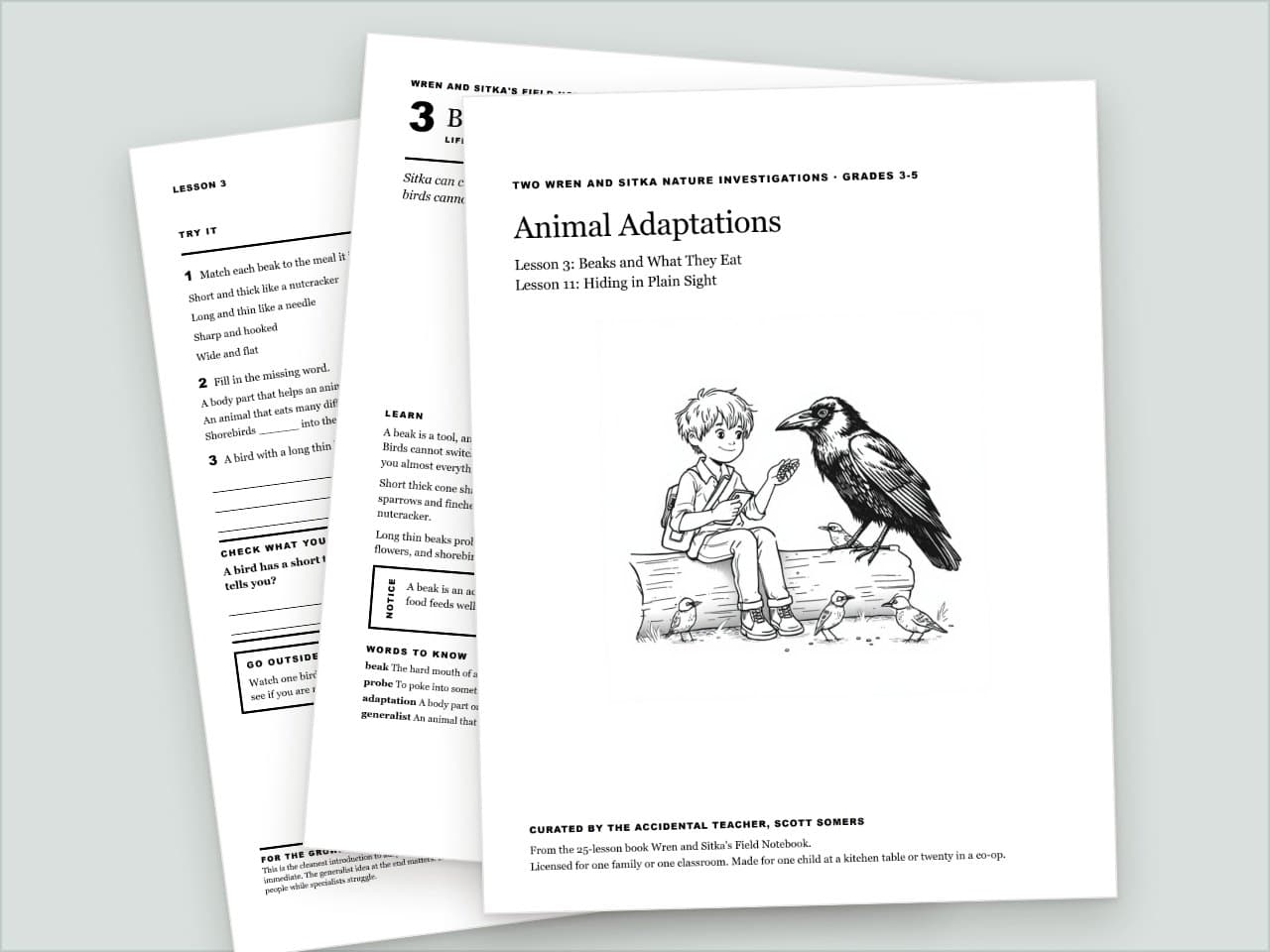
By the end of this
- Your child can look at a bird's beak and say what it most likely eats
- Your child can tell camouflage from mimicry and say what each one is telling a predator
Your child is ready for this if they
- Reads a short paragraph without help
- Writes a sentence in their own words
- Will go outside and look at something for five minutes
That list matters more than the age we printed on it. You know which of the two is true of your child.
A beak is a tool, and like any tool it is shaped for a job. Birds cannot switch tools, so the shape of the beak tells you almost everything about what the bird eats.
Short thick cone shaped beaks crack seeds. Think of sparrows and finches. The beak works like a nutcracker.
Long thin beaks probe. Hummingbirds reach into flowers, and shorebirds push down into mud after worms and small shellfish.
Hooked beaks tear. Hawks, owls, and eagles use the hook to pull meat apart. Wide flat beaks strain water for tiny food, which is what a duck is doing when it dabbles.
A raven has a beak that does a bit of everything, which is part of why ravens live almost everywhere.
Camouflage is blending in. Matching the color and pattern of the background is the simplest kind, which is why a snowshoe hare turns white in winter and brown again in summer.
Shape matters as much as color. Some insects look exactly like a twig, a thorn, or a dead leaf, right down to fake veins and chewed edges.
Countershading is a trick you can see on fish and deer. Dark on top, pale underneath. It cancels out the shadow that would otherwise reveal a rounded body.
Mimicry is different from camouflage. Instead of hiding, an animal copies something dangerous. A harmless fly with wasp stripes is not blending in. It is bluffing.
Warning coloring is the opposite of all of it. Bright red, yellow, and black say do not eat me, and mean it.
What is inside
- 01Beaks and What They Eat — the teaching page
- 02Beaks and What They Eat — the work page, answerable from the teaching page
- 03Take it outside: Watch one bird for three minutes and try to see its beak clearly.
- 04Hiding in Plain Sight — the teaching page
- 05Hiding in Plain Sight — the work page, answerable from the teaching page
- 06Take it outside: Stand still and stare at one square of tree bark, fence, or ground for a full two minutes without moving.
Standards alignment, for a portfolio or a state filing
2 alignments. Copy what your state asks for and ignore the rest — this is here for the paperwork, not for the teaching.
| Framework | Code | What it covers |
|---|---|---|
| NGSS | 3-LS4-2 | |
| NGSS | 4-LS1-1 |