Food Chemistry: The Science of Cooking and Nutrition
Ages 14 to 18
A full year of high-school chemistry, taught in your own kitchen. Thirty-six weeks, forty-six labs, every lab sheet ready to print.
By the end of this
- Your child can measure to a hundredth of a gram, keep a lab notebook, and say how far a number can be trusted
- Your child can work out moles, molarity, mass percent and percent error from their own kitchen measurements
- Your child can explain why a recipe behaves the way it does using particles, polarity, heat and rates
- Your child can plan and run a fair test, then write a conclusion that says what the evidence does and does not show
Your child is ready for this if they
- Has finished Algebra I
- Can follow a recipe and weigh an ingredient on a scale
- Can write a few sentences to explain what they saw
That list matters more than the age we printed on it. You know which of the two is true of your child.
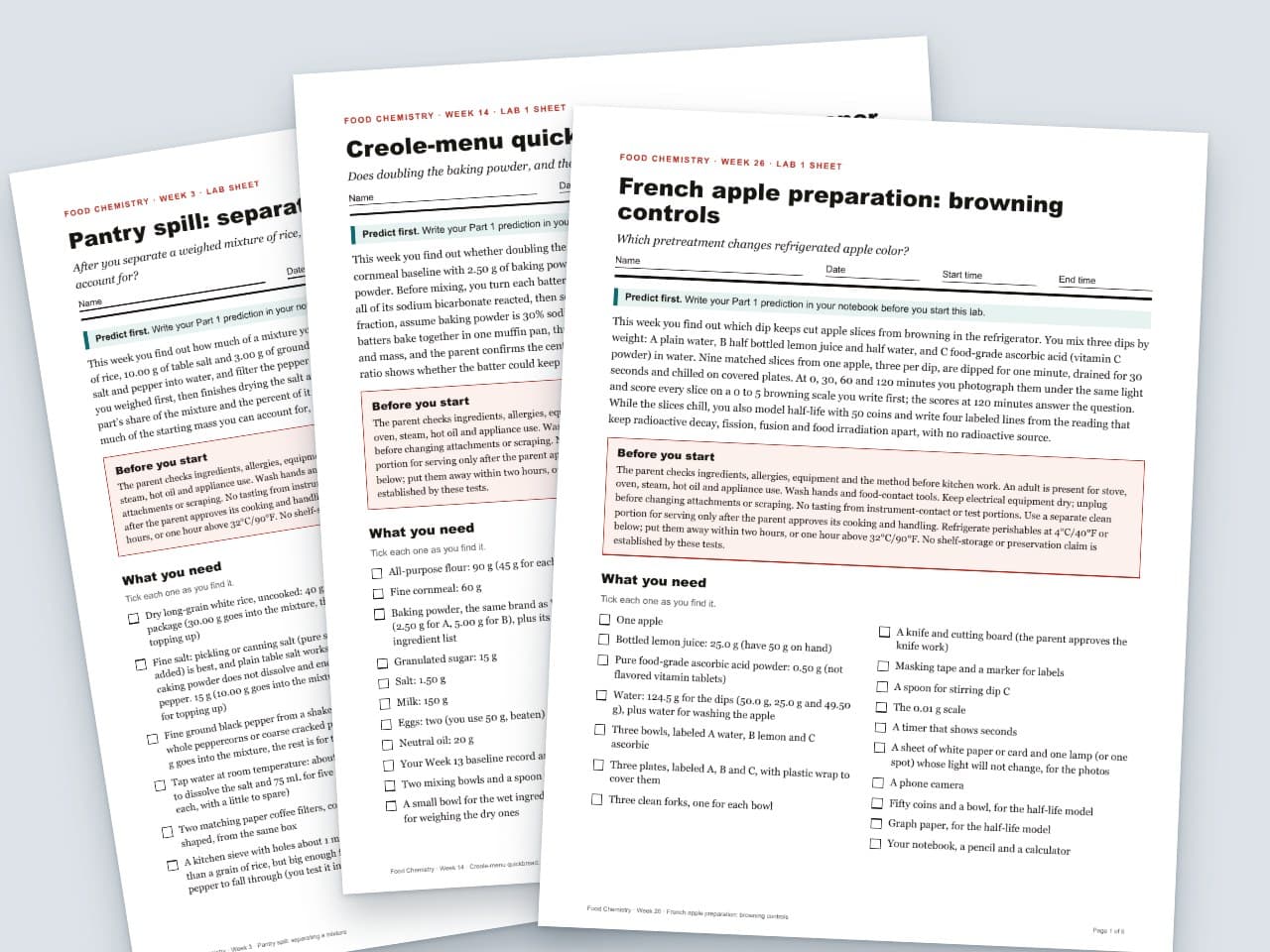
Each week your child reads three short readings, answers a few questions before the stove, and then does a kitchen lab: numbered steps, a record sheet and a printable lab sheet. The prediction comes first, written as a number with a reason. Then they cook, measure and compare. A parent checks the plan and is in the room for the stove, oven, open flame, knives and appliances, and does the hot pours. The student does the work. A parent key for every week gives the answers and shows what to look for, so you can grade without knowing chemistry.
The course starts with measuring and separating a mixture, then moves through atoms, the mole, solutions, polarity, reactions, heat, starch, enzymes, gases, acids, sauces, pasta and fat, and ends with food energy and a final product. Four capstones, in Weeks 12, 23, 27 and 35–36, have your child plan and run a whole investigation of their own.
It is planned at about 175 hours, just under five active hours a week on average, for a student who has finished Algebra I. Most weeks run four to five and a half hours. A few run longer, and the longest, Week 33, is about seven. You do not need a chemistry background. The kitchen is the lab, and you do not buy for the whole year at once: each week lists what it needs, with amounts. Ten tools carry the course, each needed only from its week: a 0.01 g kitchen scale and a digital probe thermometer (Week 1), a 10 mL oral syringe (Week 7), a conductivity tester (Week 8), safety glasses (Week 9), a butane kitchen torch if your stove is electric (Week 9), a stand mixer (Week 10), a hand mixer or a whisk (Week 11), a pH tester (Week 24) and a multimeter (Week 27).
A few labs go beyond ordinary cooking, and you should know that before you buy. Week 26 uses iodine tincture, Weeks 9 and 34 use an open flame, Week 13 makes washing soda, and some weeks use salt substitute, calcium chloride or hydrogen peroxide. The Start here page lists each one and how to store it away from younger children. Any home with a peanut or tree-nut allergy skips the second lab in Week 34.
You use the course online. After you buy, sign in on this site with the email you used at checkout (we send you a link, so there is no password) and open it on a computer, tablet or phone. Lab sheets download from inside each week, ready to print. If you would like a copy to keep, the whole course is also one download you can save to a computer and use without the internet. The readings are written for this course. Where they build on OpenStax Chemistry 2e and Biology 2e, they say so and credit those books under CC BY 4.0, and they link to the free sections for anyone who wants more.
What is inside
- 01Start here: how a week runs, the tools you need, safety and grading
- 02Thirty-six week pages: three readings, the questions, and the lab
- 03Forty-six printable lab sheets to download (ten weeks carry two labs)
- 04Eight units, each with its own page
- 05A week finder
- 06The lab shelf: every lab sheet in one place
- 07A parent key for every week: the answers, the worked steps, and what to look for in each prediction, lab and explanation